
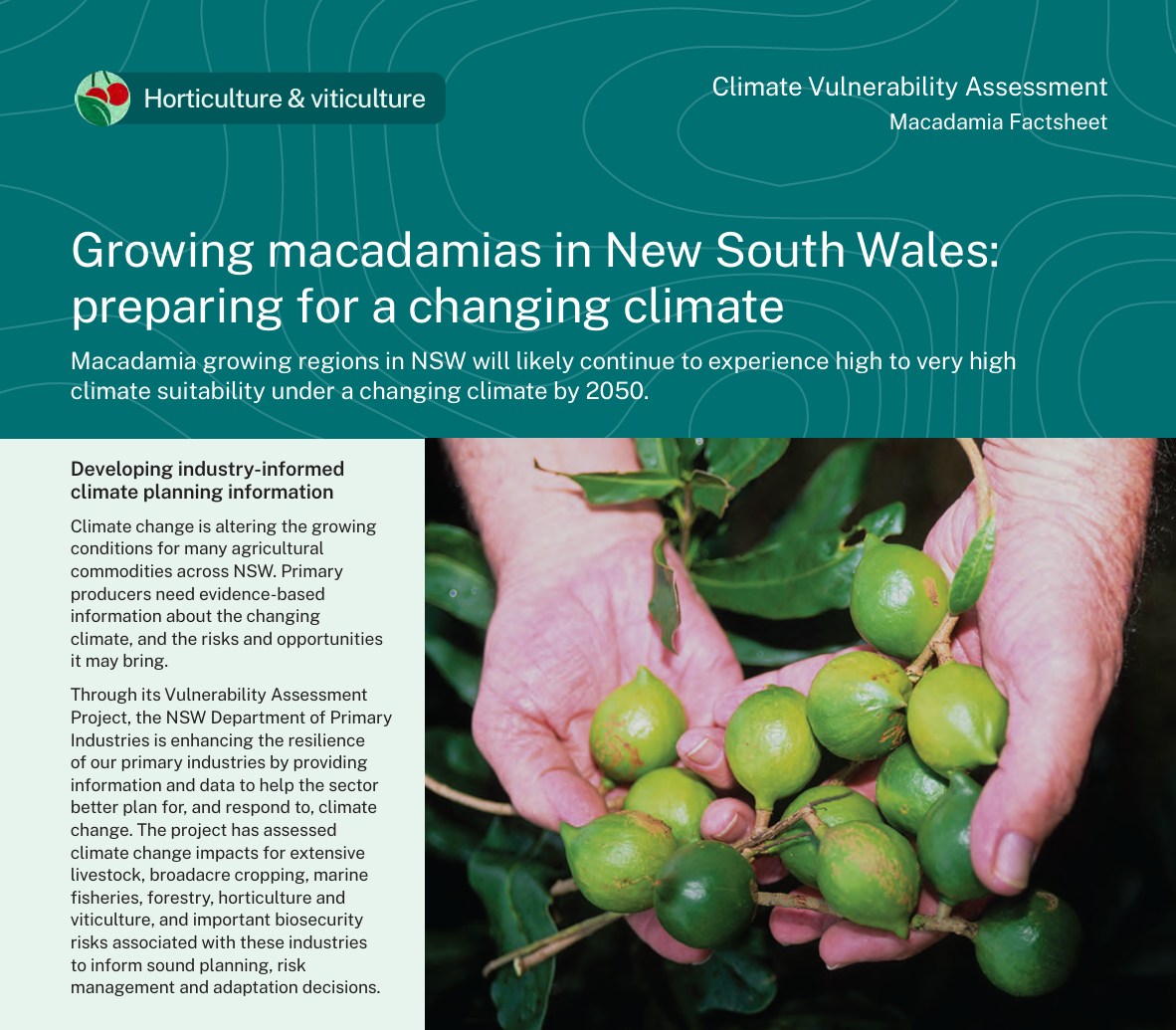
Photo credit: A factsheet produced by the Department of Primary Industries. Source: View source ↗
SHORT SOLUTION · TECHNICAL TOOL
Key information
| Title | Translating Climate Science into Action for Primary Industries |
| Region and Country | New South Wales, Australia |
| Hazard | Cross-Cutting Resilience |
| Action Type | Technical Tool |
| Strategy or Guiding Policy | NSW Climate Change Adaptation Action Plan 2025-2029. The action is Action 37 of the Plan. |
| Key links | Climate Change Vulnerability Assessment for Primary Industries |
Action Description
Translating Climate Science into Action for Primary Industries is a New South Wales Government action that strengthens the capacity of the state’s agriculture, fisheries, and forestry to understand and adapt to a changing climate. These sectors are central to the state’s regional communities, cultural identity, food security, and economic prosperity, contributing around AUD 21 billion to the NSW economy in 2022-23. The Climate Vulnerability Assessment provides a consistent foundation to map future adaptation pathways for stronger, more resilient primary industries across the state.
The NSW Department of Primary Industries and Regional Development has delivered a comprehensive assessment of climate risks and impacts on primary industries in NSW, publishing findings, methodology, and sector-specific results across horticulture and viticulture, fisheries, livestock, forestry, broadacre cropping and biosecurity. The assessment covers 28 commodities and 14 biosecurity risks, selected primarily for their value or importance to the state, with some emerging commodities and risks included and a geographical spread of industries across New South Wales. This assessment sets out the challenges ahead and identifies where investment in adaptation to underpin future productivity and sustainability is required to enable government and industry to act now.
The Assessment focuses on building knowledge among primary producers, industry groups, government agencies, and trusted farm advisor networks. By helping these stakeholders identify climate risks, understand their implications, and implement adaptive strategies, industry is prepared for future climate impacts. By recognising shared future climate risks, and fostering collaboration at all levels across the state to embed climate resilience into everyday decision-making, this work supports development of effective adaptation policies and programs.
At the heart of this work is a commitment to translating climate science research into accessible, actionable tools and resources. Developing this capability across the NSW public sector, local governments, and industry stakeholders equips decision makers to embed climate adaptation into everyday choices, strengthening climate resilience across all sectors.
Impacts
Outcomes from the Climate Vulnerability Assessment have been used across NSW to support decision-making in climate risk management, biosecurity risk management and land-use planning. The results have provided insights for climate risk workshops, informed biosecurity management and training programs, and assisted local governments with land-use and strategic planning decisions. They also provided evidence for the NSW Climate Change Risk and Opportunity Assessment and the NSW Climate Change Adaptation Action Plan. The data underpinning each assessment is published through the NSW Sharing and Enabling Environmental Data (SEED) portal. The Assessment won the Climate Change and Resilience category of the Planning Institute of Australia (PIA) National Awards for Planning Excellence in 2026 and of the PIA NSW Awards in 2025.
Cost / Funding source
The Climate Vulnerability Assessment was funded by the NSW Government’s Climate Change Fund as one of seven projects initially funded under the Primary Industries Climate Change Research Strategy. The Strategy invested AUD 29.2 million across its projects. No separate figure is published for the Assessment.
Best Practice Principles
Assess every sector with one method. Applying a consistent approach across commodities and biosecurity risks makes results comparable, so the government and industry can see which sectors face the greatest risk and where adaptation investment is needed.
Publish the method, results and data together. Releasing the methodology, sector-level results and underlying data openly lets councils, agencies and industry apply the evidence in their own planning.
Reach producers through trusted advisers. Directing climate risk information to industry groups and farm advisor networks, as well as producers and agencies, brings it into everyday farm decision-making.
Feed sector evidence into state-level adaptation planning. Designing a sector assessment so its outputs can inform the state’s climate risk assessment and adaptation plan connects sector research directly to government policy.