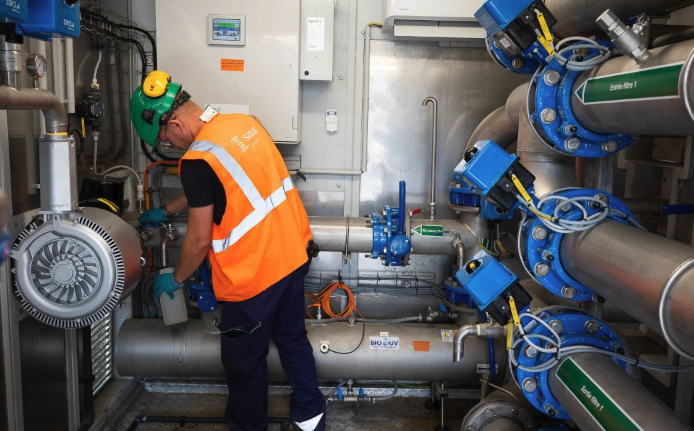
Photo credit: Wastewater treated at the Narbonne-Plage wastewater treatment plant collected top be used in vineyards, Source: Xavier Remongi View source ↗
SHORT SOLUTION · WATER REUSE
Key information
| Title | Réutilisation des Eaux Usées Traitées (REUT) Treated Wastewater Reuse for Agricultural Irrigation |
| Region and Country | Occitanie, France |
| Hazard | Drought |
| Action Type | Infrastructure; and Policy |
| Maturity | Committed since 2018 |
| Strategy or Guiding Policy | Treated Wastewater Reuse (REUT) did not originate from one sole strategic document, rather the solution developed through three framework plans: Région Occitanie Regional Water Plan (2018); French national Plan Eau 2023; State Plan de Résilience Eau des Pyrénées-Orientales (2024). |
| Key links | Montpellier REUT Overview CAHIER METHODOLOGIQUE: La réutilisation des eaux usées traitées en Occitanie |
Action Description
Région Occitanie has made treated wastewater reuse (Réutilisation des Eaux Usées Traitées, REUT) a central pillar of its water policy, with the aim of becoming France’s leading region for water reuse.
REUT applies an additional level of treatment to water leaving a wastewater treatment plant and redirects it to productive use instead of discharging it to rivers or the sea. In agriculture, this creates a controlled irrigation supply independent of rainfall, river flows and groundwater.
The Region first committed to developing REUT in its Plan d’Intervention Régional pour l’Eau (2018). Its Plan Régional Eau, adopted in June 2023, sets a target of 10 million m³ of reused water by 2030. The Region also publishes a methodological guide for REUT project sponsors, co-funds a call for water reuse projects with the Adour-Garonne Water Agency and Région Nouvelle-Aquitaine, and channels EU agricultural funds (FEADER) to reuse schemes.
The programme began with a carefully designed pilot to answer the questions that hold adoption back: is treated wastewater safe for crops, for wine quality, and for the environment? IrriAlt’Eau, a collaborative research and development project led by INRAE (the French National Institute for Agricultural Research and Environment) at its Pech Rouge experimental vineyard in Gruissan, Aude, ran controlled irrigation trials from 2013. Two vine varieties, Viognier and Carignan, were irrigated under four different water conditions and monitored across more than 50 parameters, from treatment plant discharge to vine tissue to finished wine composition. After a decade of evidence-building, the answer was clear: it works, it is safe, and it delivers an unexpected co-benefit. Treated effluent naturally contains nitrogen, phosphorus, and potassium, meaning it acts as a fertilizer, reducing synthetic input requirements by up to 80%.
With the science validated, the pilot moved to operational scale. The full IrriAlt’Eau system became operational in June 2022. A tertiary treatment unit was installed at the Narbonne-Plage wastewater station. The treatment unit added UV disinfection, filtration, and chlorination on top of standard secondary treatment. This unit was connected via a 7.6-kilometre drip irrigation network to 81 hectares of vineyard managed through a landowner-run collective body, the Authorised Syndical Association of Gruissan. The system distributes 61,000 m³ of treated water per year.
The approach has since scaled to France’s largest agricultural REUT scheme. At Argelès-sur-Mer in the Pyrénées-Orientales, a department in historic drought, the Communauté de communes Albères-Côte Vermeille-Illibéris began construction in July 2025, and the plant entered service in May 2026.. The scheme redirects 1.3 million m³ a year, previously discharged to the Mediterranean, through 17 kilometres of pipeline to around 660 hectares of orchards and vineyards across 56 farms. Farmers pay a negotiated price of €0.20 per m³, below full cost, with the intercommunal authority covering the difference.
Who in regional government delivers this
Occitanie Water, Aquatic Environments and Risks Service (Direction de la Transition Ecologique et Energétique) leads régional REUT policy, publishes guidance and co-funds projects, including through EU FEADER funds. Intercommunal authorities own and deliver the schemes: the Grand Narbonne at Gruissan and the Communauté de communes Albères-Côte Vermeille-Illibéris at Argelès-sur-Mer, with INRAE leading the original research.
Impacts
The Gruissan scheme has irrigated 81 hectares of vineyard with treated wastewater since June 2022. The Argelès-sur-Mer scheme entered service in May 2026, supplying 56 farms with 1.3 million m³ a year of water previously discharged to the sea.
Cost/ Funding Source
Gruissan: €1.3 million, co-financed by funders including the Grand Narbonne, the State (France 2030), the Région Occitanie and the irrigators’ association.
Argelès-sur-Mer: more than €13 million, including €3.4 million from the Région Occitanie (of which €2.9 million FEADER) and €2 million from the State’s national Hydraulic Fund, of which it was the first recipient.
Best Practice Principles
Develop a pilot to address specific concerns and barriers to solution uptake. Build evidence through a long-running pilot before scaling. A research demonstrator that tracks water quality, soil, crops and final product over several seasons answers the safety questions that otherwise block adoption by farmers, regulators and buyers.
Match the treatment standard to the crop and irrigation method. Setting the level of treatment by end use, from drip irrigation of vines to direct contact with food crops, keeps costs in proportion to risk.
Agree the water price and governance with farmers early. A negotiated tariff, a joint steering committee and a farmers’ consultation body build commitment before construction, even where the public authority absorbs part of the cost to keep agriculture viable.
Combine regional, national and EU funding. Layering regional co-funding, EU funds managed through the Region and a national water infrastructure fund makes schemes viable that no single funder would carry alone.