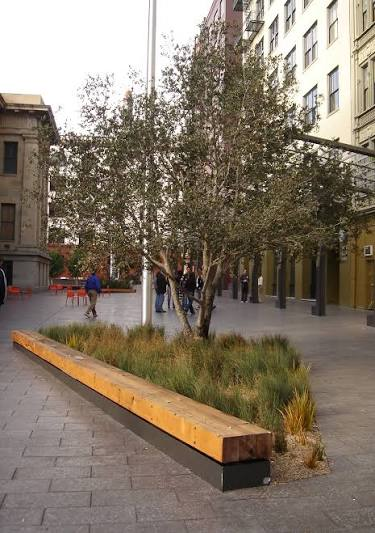
Photo credit: A rain garden integrated into a public space with seating. Source: Planning a green-blue city, a how to guide for planning urban greening and enhanced stormwater management in Victoria, View source ↗
SHORT SOLUTION · INTEGRATED WATER MANAGEMENT
Key information
| Title | Driving Integrated Water Management (IWM) Through Land Use Planning |
| Region and Country | Victoria, Australia |
| Hazard | Drought |
| Action Type | Policy or Regulation |
| Strategy or Guiding Policy | Water for Victoria (2016), the state’s long-term water plan, and the Water Cycle Climate Change Adaptation Action Plan 2022-2026, the legislated adaptation plan for the water cycle system. |
| Key links | The Water for Victoria Plan Water Cycle Climate Change Adaptation Action Plan |
Action Description
The State of Victoria is harnessing Integrated Water Management (IWM), a holistic and collaborative framework to sustainably manage water resources. The IWM approach brings together government, water authorities and communities to ensure a secure and climate-resilient water future. IWM promotes a water-sensitive approach to urban development. The Victorian Government released the IWM Framework for Victoria in 2017 under its water plan, Water for Victoria (2016). Fifteen IWM Forums across the state bring together councils, water corporations, catchment management authorities and Traditional Owners to plan and deliver projects.
Since 2018, Victoria has embedded IWM objectives into its Planning Policy Framework, requiring local councils to apply its principles in land-use planning decisions. Planning reforms in October 2018 (Amendment VC154), based on the recommendations of the Improving Stormwater Management Advisory Committee, strengthened the links between water management and urban planning. Best practice stormwater management requirements in the Victoria Planning Provisions, in place for residential subdivisions since 2006 and apartments since 2017, now apply to most development types, including multi-dwelling housing and commercial, industrial and public use developments. Applicants meet these requirements on site with measures such as rainwater tanks and rain gardens. Where space or technical limits prevent this, councils can run stormwater offset schemes, in which developers pay a fee that funds larger treatment assets, such as wetlands, in the same catchment.
IWM approaches include maximising nature-based solutions to capture stormwater runoff, using recycled water for non-potable uses, and integrating water management with urban design to enhance cooling, biodiversity and community amenity. By consistently incorporating IWM into land use planning, Victoria can better identify opportunities that deliver multiple co-benefits, from waterway health and water security to urban cooling and liveability.
Who in regional government delivers this
The Department of Energy, Environment and Climate Action (DEECA) leads IWM policy, the IWM Forums and grants, and stormwater guidance, while the Minister for Planning sets requirements in the Victoria Planning Provisions. Local councils apply the requirements through planning permits and can establish stormwater offset schemes. Source ↗
Impacts
To date, Victoria has saved around one billion litres of drinking water each year through integrated water management approaches, demonstrating how local-scale projects can generate significant, cumulative benefits for climate resilience and sustainable urban water management. DEECA attributes this saving to IWM grant capital funding for 15 stormwater and recycled water projects, which also create an additional 1.4 billion litres of stormwater and recycled water a year. By March 2022, IWM Forum planning had enabled 18.3 billion litres of recycled water for high-value agriculture and attracted AUD 60.2 million in Commonwealth funding for IWM projects.
Cost / Funding source
Since 2017, the Victorian Government has co-funded 178 strategic and capital IWM projects totalling more than AUD 72 million in investment (October 2023). A further AUD 24 million IWM Grants Program opened in November 2025 for projects with councils, water corporations and Traditional Owner organisations.
Best Practice Principles
Write water management into planning rules. Embedding stormwater requirements in statewide planning provisions makes water-sensitive design a condition of development approval across most development types.
Give applicants and assessors a standard tool. A free assessment tool accepted by all councils, with online guidance by development type, lets developers show compliance and councils assess it on a common basis.
Allow off-site treatment through council offsets. Letting developers pay into a council offset scheme when on-site treatment is impractical funds larger, catchment-scale assets such as wetlands.
Plan at catchment scale through standing forums. Permanent forums of councils, water corporations, catchment authorities and Traditional Owners identify shared projects and set place-based targets that individual planning decisions cannot.