
Key Information
| Title | California Communities Extreme Heat Scoring System — CalHeatScore |
| Hazard | Extreme Heat |
| Region and Country | California, United States |
| Action Type | Heat risk and vulnerability index |
| Further Categorisation | Heat communications; heat alerts; early warning tool |
| Key links | OEHHA CalHeatScore information CalHeatScore interactive tool |
Context
Extreme heat is the leading cause of weather-related deaths in California. Heat-health risks vary widely across California’s diverse climates and communities, and the same temperature can have different health impacts depending on local conditions and who is exposed.
Populations most threatened include older adults, children, pregnant people, people with chronic health conditions and disabilities, outdoor workers, people without reliable access to cooling or hydration, unhoused individuals, and people not acclimatised to the heat levels reached in each area.
To help residents, local governments, and service providers understand and act on extreme heat risk, the state developed CalHeatScore, which is a novel statewide, public health tool that provides an accessible, consistent way to communicate anticipated heat impacts at a local scale.
Action Description
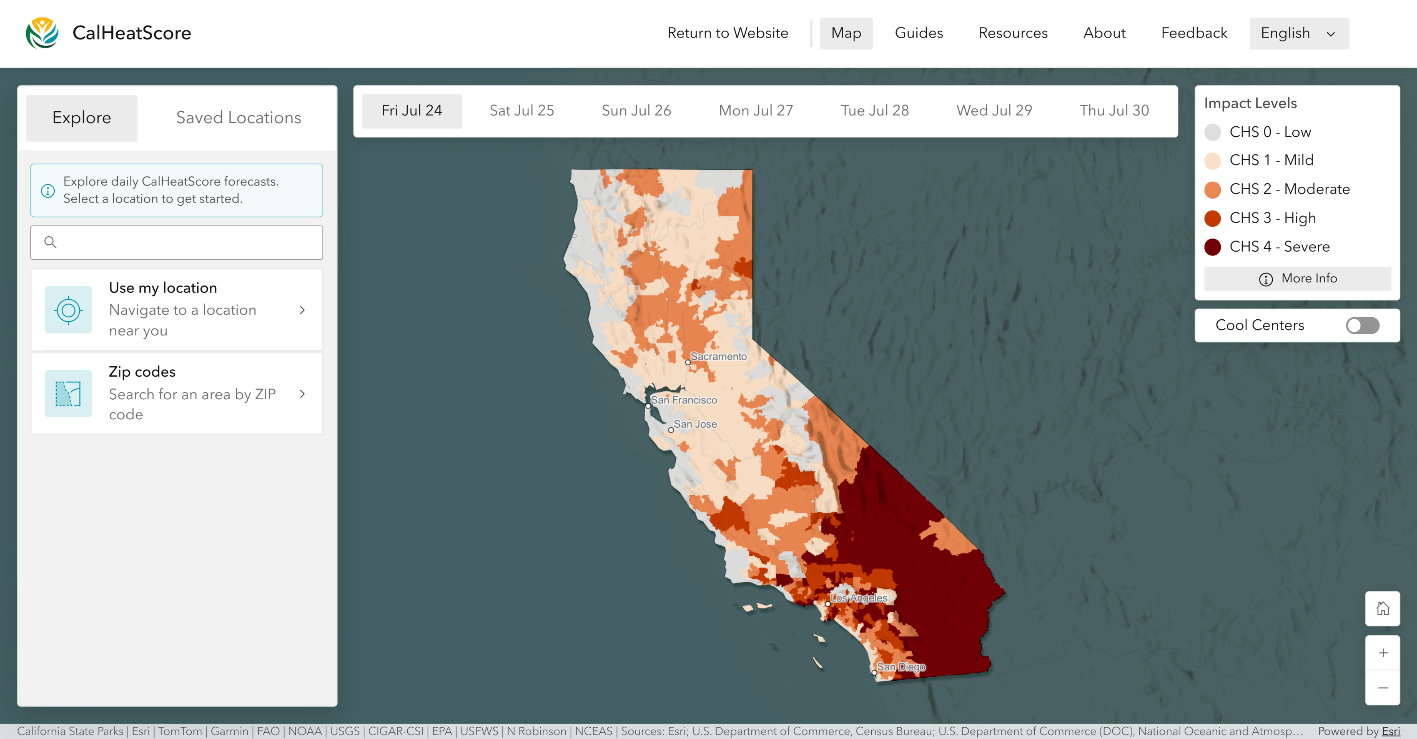
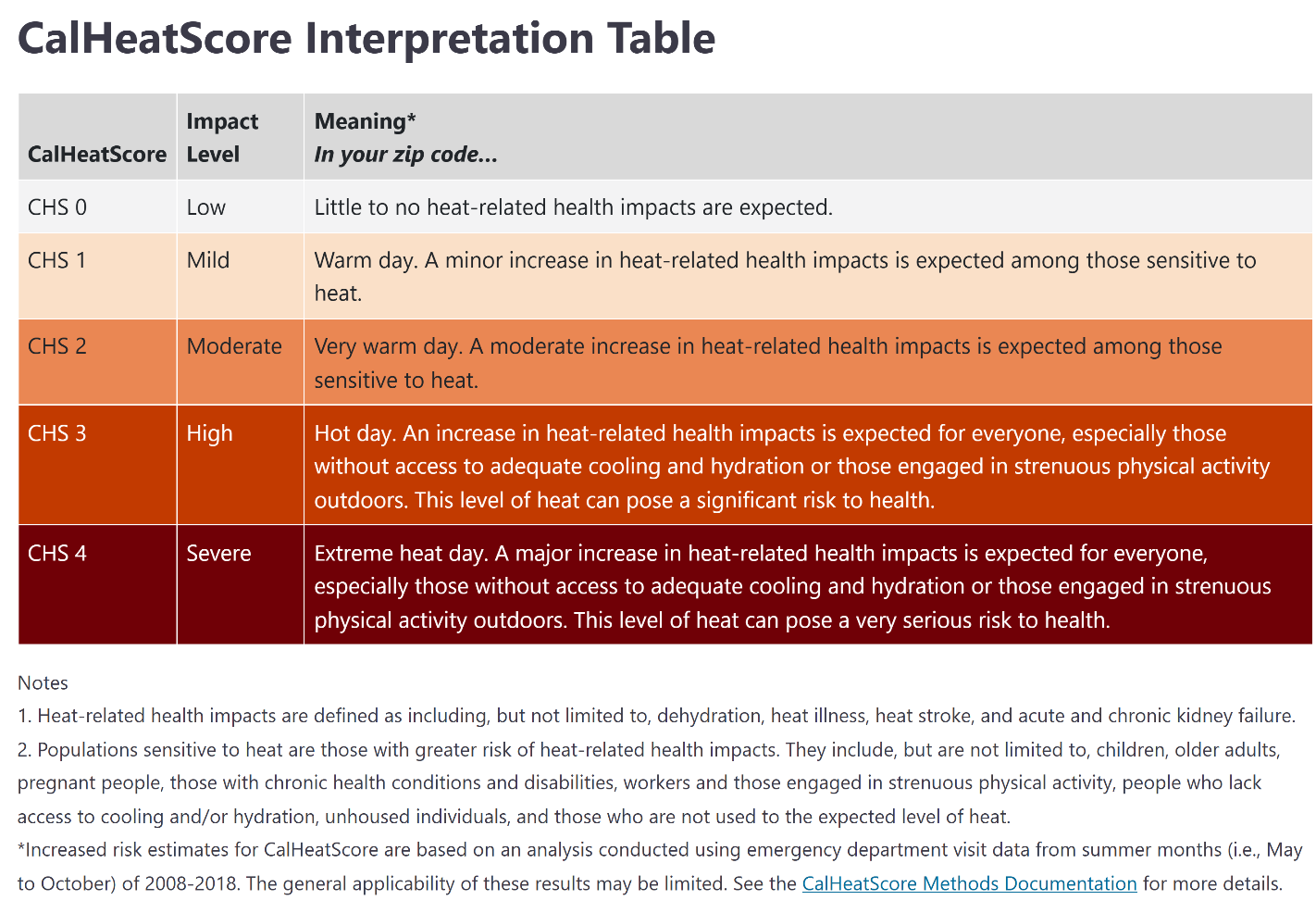
CalHeatScore is a public web-based tool that scores forecasted heat conditions for every California ZIP (i.e. post) code on a scale of 0 (Low) to 4 (Severe), indicating the level of health risk expected from the forecasted heat. Currently, forecasted heat is represented by the daily maximum Heat Index as defined by the United States National Oceanic and Atmospheric Administration’s National Weather Service definition, which incorporates air temperature as well as relative humidity.
Scores are based on forecasted heat and historical relationships between heat and emergency department health outcomes within each ZIP code. This locally tailored approach provides relevant, community‑specific information rather than relying on a single statewide temperature threshold or broader measures of heat risk.
The tool presents heat‑health risk information alongside demographic and locally relevant resources, helping communities prepare for and respond to extreme heat. It is available in English and Spanish and includes:
- An interactive map
- An API
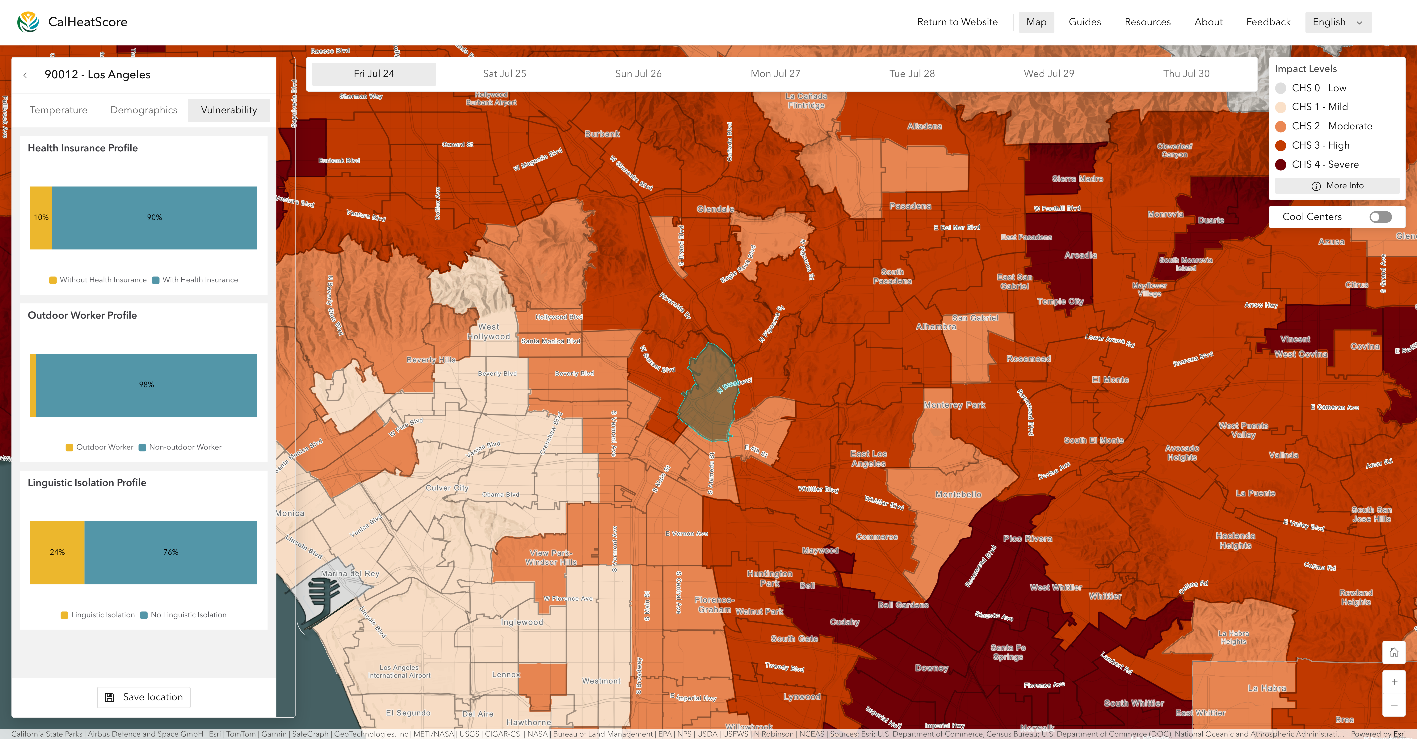
- Local demographic profiles
- Daily updated forecasts and scores
- Locations of nearby cooling centers
- Links to preparedness resources
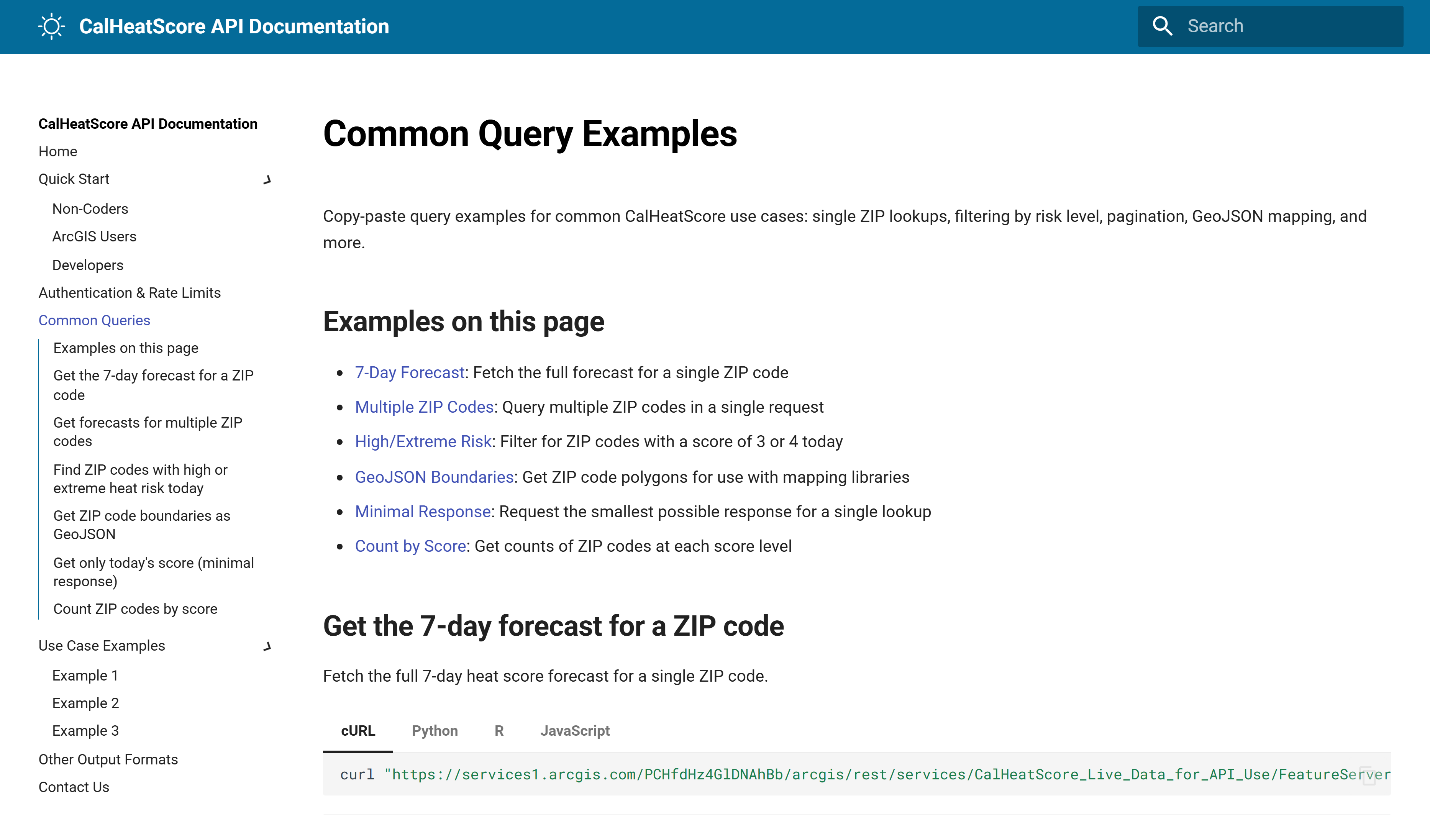
A REST API, released in 2026, enables third‑party platforms—such as public health systems, weather services, local governments, and app developers—to integrate live CalHeatScore data into existing tools. This expands the reach of heat‑health risk alerts beyond the state website.
Timeline & Evolution
In 2021, the California Department of Insurance’s Climate Insurance Workgroup recommended that the state build a system to rank heatwaves, comparable to the way tropical storms and hurricanes are ranked, to better communicate deadly heat risk to residents.
This recommendation was codified in Assembly Bill 2238 (2022, L. Rivas), which required the California EPA to develop a statewide extreme heat ranking system. The bill set specific requirements for what the system had to be based on:
- Available meteorological data on heat events
- Data on the associated health impacts,
- Measures of extreme heat severity and its health impacts,
- Locally relevant information such as urban heat island effects; and
- Public input.
It also required the Integrated Climate Adaptation and Resiliency Program to disseminate CalHeatScore information to communities and local leaders, with the Governor’s Office of Emergency Services supporting that dissemination and communications effort.
Since launch, an API interface has been added as a key upgrade, enabling third parties to integrate CalHeatScore data into their own tools and services.
- 2021: The Climate Insurance Workgroup recommends creating a statewide heat-risk ranking system.
- 2022: Assembly Bill 2238 codifies the requirement for a statewide system.
- December 31, 2024: CalHeatScore launches to the public as California’s first state-level heat-health scoring tool.
- 2025: Governor Newsom announced the tool alongside a 32 million dollar investment in May 2025 to help communities combat extreme heat, as part of the Extreme Heat and Community Resilience Program.
- 2026: CalHeatScore expands significantly with the release of its public API. CalHeatScore also releases an updated interface and user guide to improve usability. State agencies begin to integrate CalHeatScore into planning and rule-making, with the California Department of Public Health using the tool to support planning for the 2026 World Cup and the California Public Utilities Commission mandating the use of tool to determine when power disconnections should be prevented.
Actors & Governance
The Office of Environmental Health Hazard Assessment (OEHHA), is an office within the California Environmental Protection Agency responsible for assessing health risks posed by environmental exposures, owns CalHeatScore and leads its ongoing development and maintenance.
OEHHA’s Extreme Heat Ranking System Development Section administers the tool on behalf of CalEPA, and developed the underlying statistical model through a research contract with the University of California, Los Angeles Center for Healthy Climate Solutions, with research partners at Oregon State University and Applied Climatologists Inc.
Several other State Agencies support the development and delivery of the CalHeatScore:
- The Governor’s Office of Land Use and Climate Innovation: delivers California’s climate adaptation programme and consults on communication strategy and partnerships;
- The California Department of Insurance: wrote the 2024 report on heat-related insurance gaps that informs the tool’s development;
- The California Department of Public Health: advises on the development and communication of the tool as well as local applications of the tool;
- The California Governor’s Office of Emergency Services: supports dissemination and public communications.
All state agency partners more broadly provide input on improvements to the tool.
Cost & Resourcing
CalHeatScore’s current budget per fiscal year is ~$1 million, covering salaries, benefits, and operational expenses.
CalHeatScore currently employs three scientific staff and one manager.
Implementation Considerations
After AB2238 was passed, OEHHA established the Extreme Heat Ranking System Development Section (EHRSDS) made up of a team lead and three scientists. OEHHA also began leading an interagency working group to oversee the development of CalHeatScore.
EHRSDS developed and oversaw contracts with UCLA and the Los Angeles Regional Collaborative (LARC) to develop the CalHeatScore model and early communications materials.
To translate the CalHeatScore model into an operational system, EHRSDS oversaw a contract with Esri to develop a web application and supporting software to implement daily updates to the system based on weather forecasts. OEHHA maintains the system in a virtual server to maximize the reliability of daily updates and uses automated approaches to monitor updates to the system.
The passage of AB 2238 has helped to drive action: a state legislative mandate created a dedicated, funded requirement for a single state agency to build and maintain the tool over the long term.
For regions to develop an equivalent local tool, the administering authority needs reliable access to a wide range of data. This includes, but is not limited to: historical climate data, live weather forecast data, and historical health outcome data.
Maintenance of the tool is central to its useability and is ongoing: forecasts and scores update daily. As of October 2026, the underlying methodology has been revised once in January 2026. OEHHA will continue to update CalHeatScore based on research advancements and public feedback.
Engagement on and dissemination of CalHeatScore is equally as important as the technical requirements of system maintenance. CalHeatScore is designed to be a public health tool built with close community engagement to ensure the tool reflects lived experiences through measures of exposure, health vulnerability, and local resources. It also needs to be seen as useful to community members and organizations: one that helps them make informed decision at the individual and institutional level to protect themselves and others from extreme heat.
Although CalHeatScore is a statewide tool, extreme heat response and resilience often occurs at the local level. With the development of the CalHeatScore API, User Guide, and forthcoming communications plans, OEHHA is developing resources that can easily be disseminated throughout different levels of government, as well as community-based organizations, Tribes, non-profits, and others for easy heat-health risk communication.
AB 2238 also requires CalHeatScore to eventually provide recommendations on thresholds or triggers for implementing heat risk reduction policies, and recommended metrics for measuring short- and long-term health impacts; as of the state’s own background documentation.
The CalHeatScore values of 0-4 serve as temperature thresholds. These thresholds can be used for a variety of heat risk reduction policies, with the recent CPUC decision for utilities to suspend power disconnections based on a CalHeatScore of 2 or greater as an example. As CalHeatScore is disseminated further across sectors, more heat risk reduction policies are anticipated.
Co-Benefits & Trade-Offs
There are a number of co-benefits that have emerged since the tool launched. These include policy use cases to protect the most vulnerable during heat waves, innovated applications of the CalHeatScore API to get warnings to people quickly, increased state awareness of heat-related health issues across vulnerable groups, and data support for local health departments and academics studying heat-health impacts to their community of interest.
Tradeoffs are low. Producing a heat-health risk tool is a low-risk action and provides a uniform statewide approach for assessing and increasing awareness of heat-health risks. If other heat-health risk tools exist at the local or national level, the tool should be built with awareness of these tools to ensure complimentary messaging and to avoid unintended tradeoffs.
Amplifying Heat-Health Risk Information: CalHeatScore’s API allows a single state-maintained dataset to reach people through platforms they already use, rather than only through a government website. Examples of integration include California Department of Public Health heat preparedness and surveillance for the 2026 World Cup, a University of California San Francisco pilot linking the score to electronic health records for high-risk patients, and California investor-owned utilities using daily updates to the score in power shutoff decision-making.
Equity Considerations
The health impacts of extreme heat are not felt equally across communities. Social determinants of health—such as income, access to resources, and living conditions—play a critical role in how well individuals can cope with rising temperatures. The impact of extreme heat is further compounded by long-standing systemic inequities, including racial and environmental injustices, that leave certain communities more exposed and less resilient.
CalHeatScore was designed to support communities disproportionately affected by extreme heat. On the tool, each ZIP code’s profile includes demographic information such as age distribution, linguistic isolation, and outdoor worker prevalence, which can help individuals and local agencies understand who may be most at risk.
OEHHA has and will continue to prioritize community input to ensure CalHeatScore remains accurate and useful. In 2026, OEHHA supported a contract with three community-based organizations to co-design a process of prioritizing stakeholder outreach to those most impacted by extreme heat as well as those most likely to adopt CalHeatScore to increase community resilience and preparedness. The three organizations also provided input to OEHHA on the tool features, extreme heat communications, and example uses cases for the tool.
Impact & Evidence
Since CalHeatScore’s development, OEHHA has worked with partners at the California Department of Public Health (CDPH), as well at UC Davis, to develop a formal program evaluation system. This system involves determining program goals, asking specific questions to develop milestones, developing data collection methods, and collecting and analyzing data to evaluate program efficacy. OEHHA collects data to evaluate CalHeatScore in a variety of ways, including through public meetings, workshops, and surveys. This program evaluation process is a long-term and permanent component of CalHeatScore.
OEHHA tracks CalHeatScore web traffic: in 2026, 20,000 people visited the CalHeatScore tool.
Transfer Potential / Best Practice Principles
A legislative mandate for a standardised risk index with specified data inputs has resulted in the delivery of the CalHeatScore and its clear function.
Using health-based thresholds tailored to local conditions improves the relevance of the tool and supports targeted risk communication.
A region’s ability to build an equivalent tool will be reliant on their access to data, including: historical health outcome data, demographic data, and fine-resolution climate and land cover data.
Setting workable thresholds and triggers for a heat-health index requires access to historical health outcome data at fine geography, as well as climate data.
An API that allows third-party embedding is a practical model for extending reach: it demonstrates that heat risk information reaches more people when delivered through platforms they already use and trust.
Next Steps
CalHeatScore’s ongoing priorities include:
- Developing public guidance on recommended actions at each score
- Advancing ZIP code level representations of weather and climate inputs
- Continuing to conduct community engagement to refine the tool and support local adoption
- Expanding the scoring methodology to incorporate additional environmental variables and health response data
- Establishing mechanisms for assessing and validating the system
- Increasing uptake of CalHeatScore and expanding dissemination of CalHeatScore notifications including through trusted messengers