Key Information
| Title | Programa Brotar — Santiago’s urban forestation project to combat urban heat |
| Hazard | Heat |
| Region and Country | Santiago Metropolitan Region, Chile |
| Action Type | Government-funded programme delivered by a partner organisation |
| Further Categorisation | Cooling the built environment; urban greening; nature-based cooling |
| Key links | Gobierno de Santiago — Programa Brotar |
Context
Extreme heat is a primary climate risk for the Santiago Metropolitan Region (Región Metropolitana de Santiago), the regional jurisdiction of 52 communes that contains Chile’s capital. The Regional Climate Change Action Plan (Plan de Acción Regional de Cambio Climático), approved by the Metropolitan Regional Government of Santiago in April 2024, projects that the region’s urban centres will face more extreme heatwaves and a rising risk to population health. Average temperatures are already increasing. The Quinta Normal weather station records a rise of 0.19°C per decade, and 2001 to 2020 was the warmest period since 1971.
The urbanised area concentrates this heat. Large impermeable surfaces and construction materials amplify temperatures inside the city, producing an urban heat island effect. Surface temperatures exceed 35°C across the most densely populated urban areas and pass 40°C in the north of the region. A 2022 Ruhr University Bochum study, cited by the Regional Government, found that one third of the region’s population lives in an urban heat island. Within the city, the communes most affected by heat islands lie in the north-west, including Quilicura, Conchalí and Quinta Normal. Half of the region’s communes, concentrated in the western urban area, show a hot or overheating surface temperature trend.
Heatwaves increase the incidence of heat-related illness and mortality, and cases of severe illness and death from heatstroke are rising. Children and older adults face the greatest risk. On 29 January 2024, Chile’s national Ministry of the Interior, through the National Disaster Prevention and Response Service (Servicio Nacional de Prevención y Respuesta ante Desastres, SENAPRED), declared the region’s first red alert for extreme heat.
Heat exposure and the green space deficit fall on the same communes. The areas with the least vegetation cover have the highest incidence of heatwaves and are also the most economically vulnerable in the region. The four highest-income communes hold 32.2% of the region’s green area surface, while the four lowest-income communes hold 4.1%. The Regional Government’s stated objective is to make Santiago resilient to extreme heat through a fair and equitable distribution of vegetation cover.
Action Description
Programa Brotar (Programa de Arbolado Urbano para la Conservación, Prevención y Recuperación del Medio Ambiente en la RM) is the urban tree-planting programme of the Metropolitan Regional Government of Santiago. It plants low-water-use native trees in streets, public spaces, schools and reclaimed community sites in communes with low green cover and high exposure to urban heat. The programme combines public realm planting, tree distribution to residents and community organisations, municipal training, environmental education and the restoration of degraded sites. It launched in May 2023 within the Regional Government’s Nueva Alameda Providencia project for the region’s principal urban axis.
Planting is directed to communes with green space deficits, with priority given to locations with urban heat islands. Communes are prioritised by maximum daily summer temperature, vegetation cover and social vulnerability.
Brotar has five components:
- Street and public space planting. The programme plants 3,000 trees along the Alameda axis and 20 km of planting along road corridors in communes with green space deficits, within a regional target of 30,000 new trees.
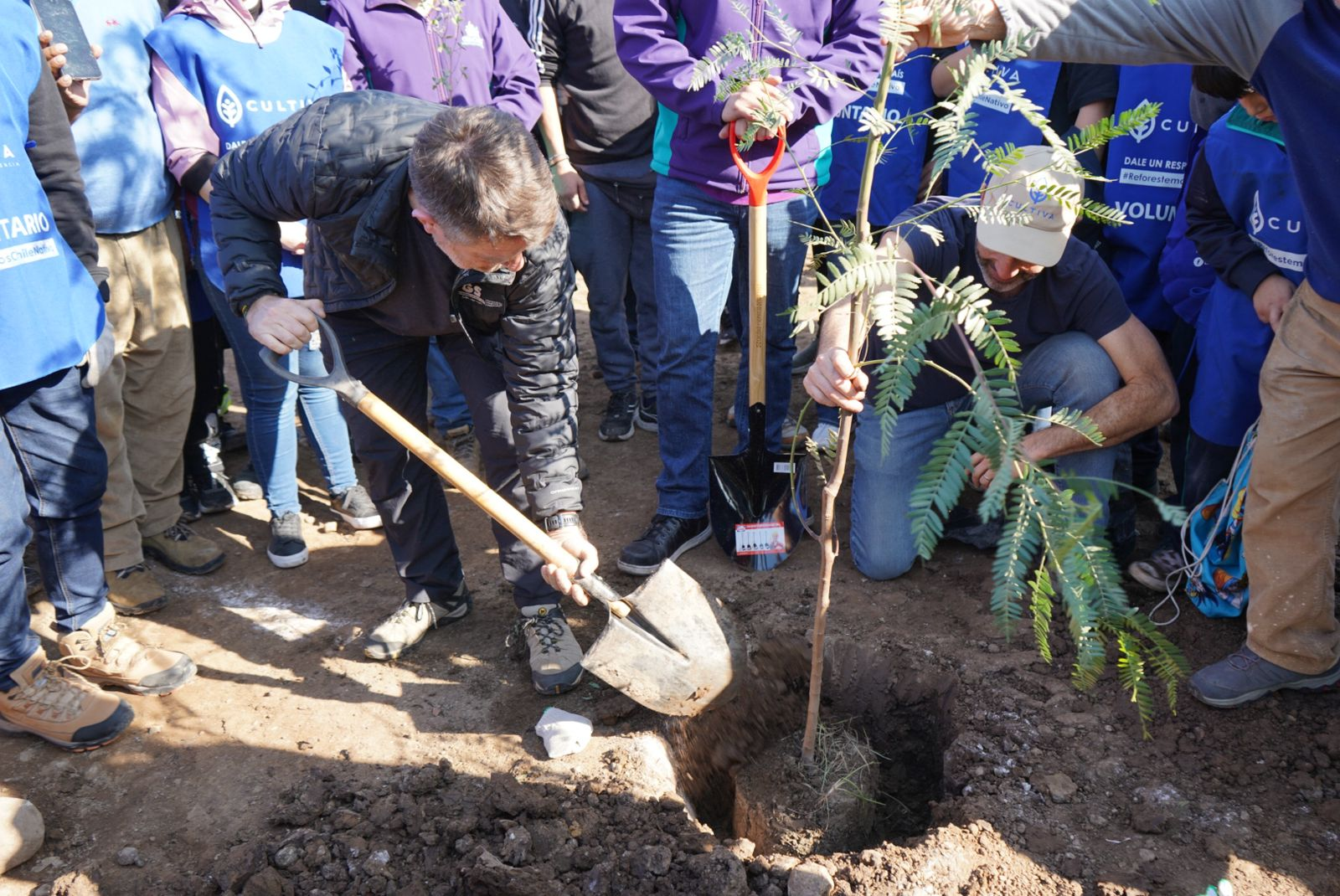
- Community urban forests. Residents plant native trees and shrubs on reclaimed sites, guided by programme monitors. Example: At a former illegal dump in the commune of Conchalí, more than 300 residents planted 459 native trees and shrubs across 4,300 m² in May 2024. This was the first urban forest financed by the Regional Government, and the site also received 351 street trees.
- Tree donation campaigns. The programme distributes 19,000 native trees to residents and to community organisations, including neighbourhood councils, schools, kindergartens and street markets. Organisations receive between 20 and 40 trees, with a planting kit, a planting manual and maintenance information.
- Training and education. The programme delivers 17 pruning and maintenance trainings for municipal teams, technical training across the region’s 52 municipalities, and environmental education for more than 4,500 children in 68 schools.
- Tree tracking. Each tree is georeferenced through Plantsss, a Chilean plant-information app that records its location and characteristics and feeds a public map of the programme’s coverage.
The programme uses native, low-water-use species. Street planting uses evergreen species such as quillay, maitén and peumo, and donation kits include quebracho, quillay, huingán, algarrobo and pimiento.
Bosques de Bolsillo (Pocket Forests)
The Regional Government runs a linked programme, Bosques de Bolsillo (Pocket Forests), which plants 33 small, dense native forests in 33 communes using the Miyawaki method. The programme was announced in April 2024 at the inauguration of a Brotar pocket forest at the University of Santiago (Universidad de Santiago de Chile, USACH), and it carries a separate budget of CLP 4,686 million. The Miyawaki method prepares the soil in depth and plants every layer of a native forest at high density at the same time, and its promoters report growth roughly ten times faster than conventional planting. Delivery is divided among several operators, with Corporación Cultiva responsible for 14 of the 33 forests. Each forest carries sensors that record temperature, humidity, pollinators, birds and soil microorganisms. The Regional Government’s stated target is 100,000 new trees by 2028.
Timeline & Evolution
Programa Brotar is in delivery. By 2024 it had planted 21,000 of its target of 30,000 trees, and by December 2025 the linked Bosques de Bolsillo programme had planted 19 of its 33 planned pocket forests.
The Metropolitan Regional Council (Consejo Regional Metropolitano) approved the programme on 22 June 2022, with funding from Chile’s National Regional Development Fund (Fondo Nacional de Desarrollo Regional, FNDR). Brotar was established as an operational framework for environmental conservation and recovery, to improve urban quality of life and strengthen preventive action on climate change. The Metropolitan Regional Government of Santiago launched the programme on 18 May 2023 within its Nueva Alameda Providencia project, with Corporación Cultiva contracted to deliver it over two years. Tree donations to residents and community organisations began on 8 July 2023.
In June 2023, residents of Conchalí, the municipality and regional authorities formed a working group to address an illegal dump in the commune. In December 2023, the programme planted a Miyawaki-method pocket forest of 600 plants in the grounds of the University of Santiago (Universidad de Santiago de Chile, USACH), planted by university volunteers. The Regional Governor inaugurated the forest in April 2024 and announced a public tender for 33 pocket forests in 33 communes, which became the separately funded Bosques de Bolsillo programme. On 25 May 2024, more than 300 residents planted Brotar’s first community urban forest on the former Conchalí dump site.
By June 2025, pocket forests had been planted in communes including Maipú, Cerrillos, Pudahuel and Vitacura. The ninth forest was planted in Parque O’Higgins on 28 June 2025 and the tenth in Peñalolén on 5 July 2025. The Regional Government’s stated target is now 100,000 new trees by 2028.
Actors & Governance
The Metropolitan Regional Government of Santiago (Gobierno Regional Metropolitano de Santiago, known as Gobierno de Santiago) owns, funds and leads Programa Brotar. The Regional Government is Chile’s regional tier of government for the Santiago Metropolitan Region, headed by a directly elected Regional Governor. Its Metropolitan Regional Council (Consejo Regional Metropolitano) approves regional investment programmes and their budgets, and it approved Brotar. The Regional Government contracts Corporación Cultiva to execute the programme, and retains ownership, funding and strategic direction.
Municipalities, the local tier of government responsible for each of the region’s 52 communes, host planting sites and co-organise plantings with the Regional Government. Municipal teams receive Brotar’s pruning and maintenance training, and technical training is offered across all 52 municipalities. Sites can also be identified through local governance processes. Example: In Conchalí, a working group of residents, the municipality, local and regional authorities, the regional office of the national Ministry of Health (Secretaría Regional Ministerial de Salud) and the Regional Government’s environment and planning department formed in June 2023 to address an illegal dump. That process led to the programme’s first community urban forest, on a municipal plot opposite the former dump. Universities and schools also host sites. The University of Santiago (Universidad de Santiago de Chile, USACH) hosted a pocket forest planted by its own volunteers, and the programme worked in 38 schools by June 2024.
Bosques de Bolsillo follows the same ownership model. The Regional Government leads the programme, the Regional Council approves it, and delivery is contracted to several operators.
The Regional Government presents Brotar as one of its regional measures on climate change and extreme heat, alongside its Code Red extreme heat protocol. An earlier regional framework, the resilience strategy Santiago Humano y Resiliente, launched on 28 March 2017 with support from the 100 Resilient Cities initiative, under the previous regional administration (Intendencia de la Región Metropolitana).
Implementation Considerations
This program is implemented by the Corporación Cultiva under contract to the Metropolitan Regional Government of Santiago. It delivers street planting, community plantings, tree donations and training through its own staff and programme monitors, who guide volunteers at planting events. Published implementation detail is limited to Regional Government releases and media coverage, and no delivery-team account is yet available.
Site selection combines commune-level prioritisation with local processes. Communes are prioritised by maximum daily summer temperature, vegetation cover and social vulnerability, and planting goes to streets, avenues and public spaces, especially where urban heat islands are present. Individual sites can also come from local governance.
Example: The Conchalí community forest followed a year of work by an intersectoral working group formed in response to residents’ complaints about an illegal dump.
Tree donations rely on recipients planting the trees themselves. Each recipient receives a kit designed so that they can plant the tree by their own means, and every tree is georeferenced through Plantsss.
Pocket forests require establishment works before and after planting. Sites in Santiago receive soil treatment and an irrigation system, and irrigation is planned to stop after three years. Cultiva states that cooling benefits appear within months and that a forest reaches its expected growth within a year. The Regional Government positions the method for specific contexts at small or medium scale.
Practitioners, officials, community organisations and academics interviewed in 2025 stated that pocket forests should be co-created and maintained with local residents. They identified three conditions for the programme to last: coordination across municipalities, stable funding for long-term maintenance, and the integration of nature-based solutions into formal planning tools. They also named safety in public spaces and sustained community engagement as ongoing challenges.
Cost & Resourcing
Programa Brotar requires four types of resource. These are a dedicated regional capital allocation, a contracted delivery organisation with native-planting expertise, large volunteer workforces for community plantings, and post-planting care that no published figure covers.
The Metropolitan Regional Government of Santiago committed CLP 1,998 million to Brotar, executed by Corporación Cultiva over two years from 2023. This is the programme’s total investment across all of its components. No breakdown by component has been published. The linked Bosques de Bolsillo programme is funded separately, with CLP 4,686 million committed to the first part of its tender for 33 pocket forests. Example: In addition to the planting at Conchalí, a further investment of about CLP 200 million in children’s play equipment was announced for the site.
Community plantings depend on volunteer labour guided by programme monitors. Plantings at Conchalí and Parque O’Higgins each drew more than 300 participants, and the Peñalolén planting drew more than 100.
Miyawaki-method forests need intensive irrigation in their first years, and Chilean practitioners of the method specify at least two years of care after planting. The method is generally more expensive than conventional planting, and the irrigation volumes needed to establish forests in Santiago’s Mediterranean climate are not yet defined. No published figure covers maintenance, and responsibility for post-planting maintenance costs is not stated. Stakeholders interviewed in 2025 identified stable funding for long-term maintenance as a condition for the pocket forests to last.
Co-Benefits & Trade-Offs
Public health benefits: Reclaimed sites throughout the metropolitan area can provide neighbourhood space and places for connection, reduce urban heat, and target sites identified by residents as a public health risk. In Conchalí, the programme turned an illegal dump that residents had reported as a health and safety problem into a community forest, and a further investment in children’s play equipment was announced for the site. Shade and lower ambient temperature are stated aims of the programme. No cooling results have yet been published.
Improved air quality: anticipated air quality impacts through capturing particulate matter on leaf surfaces and absorbing certain gaseous air pollutants, while vegetation can also help reduce dust resuspension.
Biodiversity benefits: Pocket forests plant native species at high density and are intended to create habitat in communes with little vegetation cover. Attracting biodiversity is one of the programme’s stated aims, and each forest carries sensors that record pollinators, birds and soil microorganisms.
Environmental education benefits: The programme provides environmental education to more than 4,500 children in 68 schools and trains municipal teams in pruning and maintenance. Host sites double as learning spaces. Example: The pocket forest at the University of Santiago is designed as an educational space on native forest for students and the surrounding community.
Drought-tolerant, low-water-demand planting benefits: Brotar plants native species selected for low water use and climate resistance, including quillay, maitén and peumo. This reduces the irrigation needed to establish new trees, so the region can expand tree cover under drought conditions with a lower water cost.
Civic engagement and community ownership benefits: Community plantings draw between 100 and more than 300 volunteers each, and the donation campaign places trees in the care of residents and community organisations. Stakeholders in Santiago described their long-term aim for pocket forests as neighbourhood spaces where residents take ownership, meet and form relationships.
Trade Offs
High establishment cost. Soil treatment and irrigation systems for pocket forests are costly, and Miyawaki planting is generally more expensive than conventional planting.
Equity Considerations
Brotar builds equity into site selection. Social vulnerability is one of the three criteria used to prioritise communes, and the programme’s stated purpose is to reduce the tree-cover deficit in the region’s most vulnerable sectors.
Environmental education is directed to 12-year-olds in vulnerable schools. Sites can also come from residents themselves.
Impact & Evidence
By 2024, the programme had planted 21,000 of its 30,000 trees. By June 2024, it had delivered 10,638 trees to community organisations and 4,993 to individual residents, worked in 38 schools with 1,520 trees and plants, reached 4,500 children through environmental education, and had 17 pruning and maintenance trainings for municipal teams under way. By December 2025, 19 pocket forests had been planted under the linked Bosques de Bolsillo programme.
Each pocket forest carries sensors that record temperature, humidity, pollinators, birds and soil microorganisms.
At the Independencia pocket forest on 9 January 2025, during a regional heat alert shaded air inside the forest measured 22°C, against an ambient reading of 25°C for the commune and a pavement surface temperature of 42°C. Monitoring of the forest’s cooling approach is ongoing.
The baseline for measuring the programme’s effect is commune-level green cover. In 2022, Chile’s national urban development indicator system (Sistema de Indicadores y Estándares del Desarrollo Urbano, SIEDU) recorded the region’s lowest green cover in San Ramón and Lo Espejo (4.1% of their territory), San Joaquín (4.8%), Pedro Aguirre Cerda (5.0%), La Cisterna and La Granja (5.1%), and Lo Prado (6.5%). SIEDU is maintained by the National Council for Urban Development (Consejo Nacional de Desarrollo Urbano, CNDU) and the National Statistics Institute (Instituto Nacional de Estadísticas, INE).
Best Practice Principles
Target greening using heat, vegetation cover and social vulnerability data together. Brotar prioritises communes by maximum summer temperature, vegetation cover and social vulnerability, so planting goes where heat exposure, green space deficit and disadvantage coincide. The method works with any planting technique. It requires temperature, vegetation and vulnerability data at commune level or finer.
Select native, low-water species suited to Mediterranean summers. Brotar plants native species chosen for low water use, which reduces the irrigation needed to establish trees during drought. Any Mediterranean-climate region can apply this principle using its own native species.
Plant with residents to share responsibility for new green space. Residents plant Brotar’s community forests, and its donation campaign places trees in the care of households and community organisations. Sites can also come from residents. Example: In Conchalí, a local working group identified a former illegal dump for planting.
Fund maintenance and assign site ownership beyond the planting contract. Brotar’s delivery contract runs for two years, and irrigation of pocket forests is planned to stop after three. A region adopting the approach needs a funded maintenance plan and a named owner for each site after handover. Without long-term support, pocket forests risk becoming pilot projects that fade with political cycles.
Build outcome monitoring and public reporting in from the start. Brotar georeferences every tree on a public map, and each pocket forest carries sensors for temperature, humidity and biodiversity.
Next Steps
The Regional Government plans to complete the 33-forest Bosques de Bolsillo network, with 28 forests planted by April 2026, and to plant 100,000 native plants through the programme by 2028. It has also set a wider target of 500,000 new trees for the region. That target is part of the roadmap of its Environment and Climate Action Advisory Council (Consejo Asesor de Medio Ambiente y Acción Climática), a multisector body that held its first session in July 2026.
Brotar has planted 35,000 trees, exceeding its target of 30,000. No further phase of the programme has been announced.