Key Information
| Title | Western Cape Water Resilience Strategy: Future-proofing our water security, 2025–2035 |
| Hazard | Drought |
| Region and Country | Western Cape, South Africa |
| Action Type | Strategy / Governance instrument |
| Further Categorisation | Drought management; water resource governance |
| Maturity | Adopted 2025; currently in effect |
| Key links | Western Cape Water Resilience Strategy: Future-proofing our water security 2025–2035 |
Context
Water resources in Mediterranean Climate regions are under pressure as supply becomes less predictable, and drier futures are projected. The systems which govern water in Mediterranean regions are complex and must account for a range of users and organisations involved in water management, including national and local levels of government, water utilities, catchment management authorities and many more. Comprehensive water resilience strategies can guide preparation for changing conditions and more extreme events and support the entire sector to play a role guided by clear aims and objectives.
Geographic variability in the realities of water supply and management make regional strategies a necessity- they can downscale national frameworks while taking into account regional realities to build resilience to drought. The Western Cape is South Africa's only winter-rainfall Mediterranean climate region, facing a distinct pattern of drought and flood risk compared to the rest of the country, which is dominated by summer-rainfall systems.
Action Description
The Water Resilience Strategy for the Western Cape (2025-2035) (The Strategy) is an all of society strategy that outlines a forward looking and integrated framework for water resilience.
The strategy works to state one shared vision:
…To futureproof the Western Cape by ensuring water security and equitable access to water that meets the needs of all users…
This vision sits above four focus areas, each carrying a quantified 2035 target, and six guiding principles: equity and access, resource stewardship, responsible water resource management and use, sufficiency for growth, governance and accountability, policy coherence and innovation.
The four focus areas:
- Water Conservation and Demand Management. The first response to water scarcity is to work through efficiency in water use, infrastructure, and planning. A central target is cutting overall provincial water demand by 40 million cubic metres a year by 2035, including reducing “non-revenue water” (water produced but not paid for, due to leaks, unauthorised use, or billing errors) to below 25 percent. The province's current non-revenue water rate is 27.9 percent, against a national average of 47.4 percent – some areas within the province achieving even greater rates: City of Cape Town, the only metropolitan area in the region, is at 15%.
- Water Augmentation. Reducing dependence on any single water source, through restoring wetlands and catchments, developing groundwater, reusing treated water, harvesting stormwater and rainwater, recharging aquifers, and desalination. The target is securing an additional 310 million cubic metres a year of water by 2035.
- Infrastructure Management, Development and Maintenance. Treating built infrastructure (pipes, dams, treatment plants) and ecological infrastructure (wetlands, catchments) as assets needing lifecycle management, digital monitoring tools, and better management systems, with a shift toward preventive maintenance over emergency repair.
- Governance. Coordinating delivery across government departments and external partners through the Strategic Water Resilience Committee.
The strategy covers the entire Western Cape region, and its socio-economic scope encompasses society as a whole. It aims to ensure water security and equitable access. The strategy takes into account five threats to the provinces water security:
- climate change and ecological decline disrupting freshwater supply,
- demand exceeding the capacity of the water supply system,
- infrastructure not built for current population and economic activity,
- water losses,
- and governance and capacity gaps across different levels of government
The strategy addresses the specific vulnerabilities of the province's key water catchments while accounting for inter-municipal and inter-district water dependencies. It is an umbrella strategy: it draws together existing plans, including the Western Cape Climate Change Response Strategy, the Sustainable Water Protection Plan, and the Growth for Jobs (G4J) economic strategy, along with national water sectoral plans, rather than replacing them.
The Strategy is a crucial example of a strategic framework that works to:
- Clarify the core objectives for an entire system
- Convene stakeholders to work together for water resilience
- Connect to key international goals and frameworks and local realities in water management.
Timeline & Evolution
The strategy builds on over a decade of Western Cape water planning, including the Western Cape Sustainable Water Management Plan (2012, updated 2018), the Berg River Improvement Plan (2013), and the Eco-Invest Programme (2015) [1].
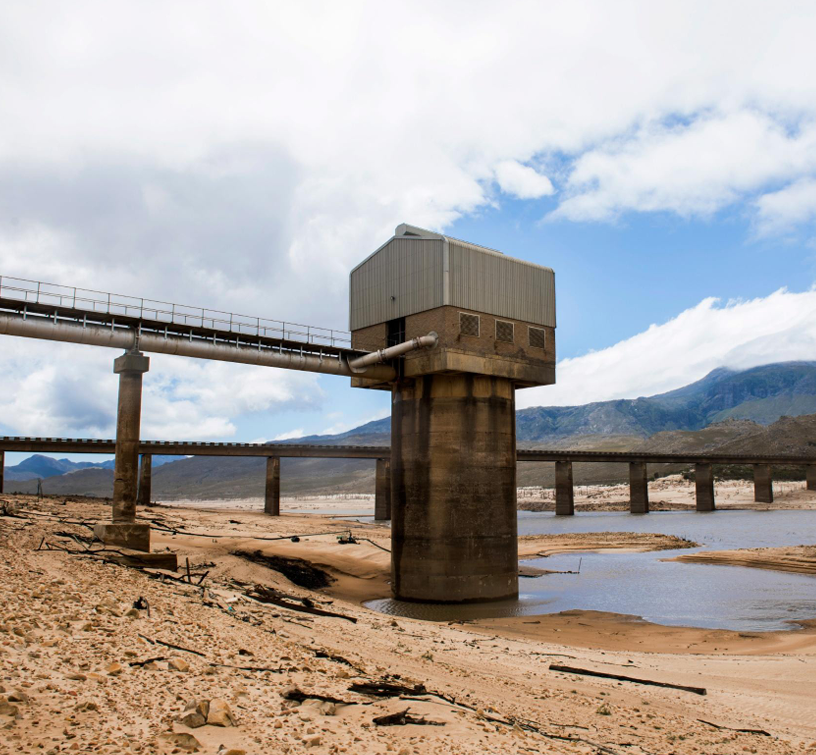
The 2015 to 2019 Day Zero drought was the catalyst that shifted this planning onto a province-wide resilience footing. It led to the Ecological Infrastructure Investment Framework (2021) and the 15-Year Western Cape Integrated Drought and Water Response Plan (2022).
The Water Resilience Strategy was approved on 27 August 2025, and the Western Cape Government publicly launched the strategy shortly after. It commits to review at least every five years.
Actors & Governance
The Department of Local Government (DLG), within the Western Cape Government, owns the Water Resilience Strategy and leads its ongoing delivery, chairing the Strategic Water Resilience Committee that coordinates implementation across departments and reports progress to the Premier’s Provincial Energy and Water Council.
“A water resilience strategy for the Western Cape is necessary to streamline and coordinate our initiatives across our various mandates, optimising our collective resources and capacities to achieve our common and agreed upon goals for a Water Resilient Province.”
The Western Cape Government, as a sub-national government, has no direct legal mandate over water resources under South Africa's National Water Act (1998), the primary national law governing water. Its only formal role under the Water Services Act is to monitor the performance of water services institutions.
The Provincial Government’s influence over water security comes through concurrent constitutional functions it shares with national government, covering agriculture, disaster management, the environment, and pollution control, and through its constitutional role of supporting, monitoring, and building the capacity of local government, under the Municipal Finance Management Act.
Within the provincial government, roles are split across departments: the Department of Local Government (DLG) leads the Water Resilience Committee and the municipal interface for water, sanitation, and disaster management; the Western Cape Department of Agriculture (WCDoA) covers agricultural water use; and the Department of Environmental Affairs and Development Planning (DEA&DP), with the public entity CapeNature, covers catchment management and ecological infrastructure.
Delivery is coordinated by the Strategic Water Resilience Committee (SWRC), chaired by the Head of DLG and supported by the Heads of DEA&DP and WCDoA. The SWRC reports progress and risks to the Energy and Water Council, a higher provincial body that aligns water resilience priorities with the province's wider energy and infrastructure planning.
The strategy's development drew on consultation across government, business, and civil society. National departments consulted include the Department of Water and Sanitation. Water boards and catchment agencies consulted include the Breede-Olifants Catchment Management Agency (BOCMA), the lead body for water resource management within the Breede-Olifants Water Management Area, and the Western Cape Water Users Supply System Water Users Platform, which is convened by the Western Cape Economic Development Partnership (EDP) [1]. The EDP is a separate, non-government collaborative organisation that convenes multi-actor platforms across several Western Cape policy areas.
Business representation in the strategy's development is extensive: forestry and agricultural bodies including the SA Table Grape Industry, Grain SA, and the Wool Growers Association, alongside industry chambers including Business Western Cape and the Cape Chamber. Civil society organisations consulted include the Development Action Group and the Isandla Institute as well as several environmental organisations.
Implementation Considerations
The Strategy is implemented through the Strategic Water Resilience Committee (SWRC), which coordinates delivery across departments and reports progress and risks to the Premier’s Energy and Water Council. Whilst the implementation tracks all the provincial government’s water resilience efforts, it also seeks to consolidate information on what the national Department and Catchment Management Agency undertake within the region. In addition, we try to get a view of the work contributed by landscape partners from the civic and non-governmental organisations. The Strategy works by setting targets and proposing partnerships, then relying on the responsible bodies to carry them out. This approach is shaped by the Western Cape Provincial Government’s lack of direct legislative authority over water resources. Rather than mandating action, it works as an influencing document: it sets targets and proposes partnerships, then relies on other bodies to take those proposals forward.
The Strategic Water Resilience Committee is the central delivery structure. It is intended to align water resilience priorities with the province's broader energy and infrastructure budget discussions and cross-sectoral decision-making, and to synthesise technical input and progress updates for escalation to the Premier’s Energy and Water Council.
As an example of coordinated action and conveying for outcomes: the strategy proposes partnerships with engineering institutions, state-owned enterprises such as the Trans-Caledon Tunnel Authority and CapeNature, catchment management agencies, and water funds to help municipalities restore and upgrade infrastructure, while separately asking National Treasury to reward good maintenance performance and prioritise ready-to-build resilience projects in the national infrastructure pipeline.
The strategy had to take into consideration a range of legislative frameworks that align mandates across national, provincial and municipal levels to ensure sustainable water management.
Cost & Resourcing
No total implementation budget is given. The strategy sets out funding through:
- National grants, including the Water Services Infrastructure Grant, the Regional Bulk Infrastructure Grant, and incentives linked to Green Drop and Blue Drop certification
- Provincial budget integration through the Medium-Term Expenditure Framework which provides a 3 year financial planning cycle.
- Private sector and blended finance, including green bonds, water bonds, public-private partnerships, and development finance institutions
- Municipal co-investment, backed by a Provincial Treasury requirement that municipalities ring-fence 15 percent of service revenue for infrastructure operation, maintenance, and repair
- Performance-based funding tying infrastructure grants to governance improvements and delivery results
Co-Benefits & Trade-Offs
Water supply resilience underpins continued functioning of all critical systems. A coordinated approach to water supply resilience enables more stakeholders to contribute to supporting the region’s vision. Some key co-benefits are set out here
Water resilience is directly linked to the Western Cape’s Growth for Jobs economic target of building a R1-trillion economy by 2035. Water security is critical for agricultural output, investment and business continuity across the Western Cape.
Resilience of primary industries, especially agriculture. In the Western Cape, agriculture holds the largest single water allocation in the province and faces harsher curtailment than domestic or industrial users during shortages.
Trade-offs: funding for water infrastructure competes with other public priorities, particularly housing.
Equity Considerations
Equity and access is one of six foundational principles and applies across the strategy and its delivery to guide a holistic approach to managing water. The strategy also sets out a dedicated approach to gender and rights-based planning, recognising that women, girls, people with disabilities, and other at-risk groups carry an unequal burden of water insecurity.
Impact & Evidence
The strategy was adopted in August 2025. No publicly available monitoring data exists yet but will be published annually from late 2026.
The strategy's own governance rationale states that a dedicated water resilience strategy is needed to bring the province's initiatives together across its various mandates and make effective use of its collective resources and capacity toward a shared set of goals.
Baseline figures against which the 2035 targets are set: non-revenue water at 27.9 percent, against a national average of 47.4 percent. Of the province's 124 water supply systems, 15 (12 percent) held Blue Drop certification in 2023, against a 2035 target of 80 percent [1].
Best Practice Principles
A regional or provincial government with limited direct legal authority over water can still coordinate the system, by setting one vision, breaking it into a small number of focus areas, and attaching a measurable target to each one. The Water Conservation and Demand Management target, cutting demand by 40 million cubic metres a year by 2035, is a working example of setting a precise, checkable regional target while still relying on the wider system to deliver it.
Quantified target-setting under each focus area gives other government departments, municipalities, and private partners something concrete to align delivery against, rather than high-level ambition alone.
A dedicated committee that coordinates delivery and reports up through an existing higher body, rather than a new institution, is a governance model that harnesses existing structures for efficiency.
Next Steps
An Implementation Plan, translating the strategy's targets into specific, timed actions and confirming resourcing, is to be finalised following the strategy's approval. Annual reporting expected late 2026 onwards.
The strategy commits to a formal review at least every five years.