
PILOT CASE STUDY · SOURCE-BASED SUMMARY
A comparative research initiative examining how California and the Western Cape use subnational collaboration to strengthen biodiversity spatial planning.
Context
Mediterranean-climate regions share biodiversity pressures that cross administrative and national boundaries. The MCAP Secretariat and member regions participated in research conducted through the University of California, Berkeley’s Rausser College of Natural Resources.
Description
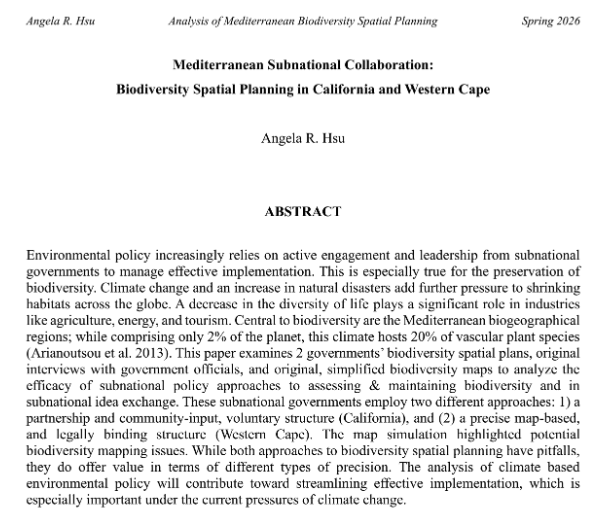
The work compared policy strategies and regional circumstances in California and the Western Cape. It considered how a collaborative partnership can advance biodiversity policy and support regions in adapting useful approaches from their peers.
Actors & governance
The initiative connected MCAP member regions, the MCAP Secretariat and university research. Its emphasis was subnational planning, cross-coordination and exchange between regional governments.
Transfer potential
The transferable principle is structured exchange between regions with comparable climates. Policy approaches can inform one another while administration and implementation remain tailored to local governance and ecological conditions.