
Key Information
| Title | Operational Plan to Prevent the Effects of Heatwaves on Health (POCS) |
| Hazard | Extreme Heat |
| Region and Country | Catalonia, Spain |
| Action Type | Governance instrument / operational plan |
| Further Categorisation | Interdepartmental health emergency plan; heat alerts; public health preparedness |
| Key links | POCS Summer 2025 operational plan |
Context
Rising temperatures and longer periods of extreme heat have significant implications for human health across mediterranean regions. These impacts are more acute in urban areas, and it is known that elevated and sustained heat for days causes excess mortality, which ranges from 12% to 40% in developed countries.
As a result of the 2003 European heatwave, mortality rates across seven monitored municipalities in Catalonia increased by 53 percent in comparison to the same time the previous year. Sustained high heat increased unscheduled hospital admissions across Catalonia; raising the rate by 7.5 percent during the months of July and August 2003.
Extreme heat raises the chances of mortality, particularly among the most vulnerable (i.e., older individuals and those with chronic conditions). Given the significant impact, Catalonia decided to develop its own Operational Plan to Prevent the Effects of Heatwaves on Health (PCOS), which was publicated two years after the 2003 European heatwave, in 2025.
Action Description
The Operational Plan to Prevent the Effects of Heatwaves on Health (POCS) is an interdepartmental and multidisciplinary plan, designed to be operational across all its areas of application, a comprehensive strategy to mitigate health risks associated with heatwaves by implementing early warning systems, public education campaigns, and coordinated responses among healthcare providers. An app from the Meteorological Service of Catalonia issues alerts to users when temperature exceeds a certain threshold.
The plan is coordinated by the Public Health Agency of Catalonia (ASPCAT) and the Catalan Health Service, and is updated annually to adapt to environmental circumstances and climate change. The system integrates real-time meteorological modelling allowing the participant departments to issue automated, color-coded alerts days before a threshold is crossed. The response embeds year-round readiness so frontline social care, transport, and utilities trigger mitigation steps immediately upon warning rather than scrambling reactively. POCS reactivates annually from June to September with three objectives:
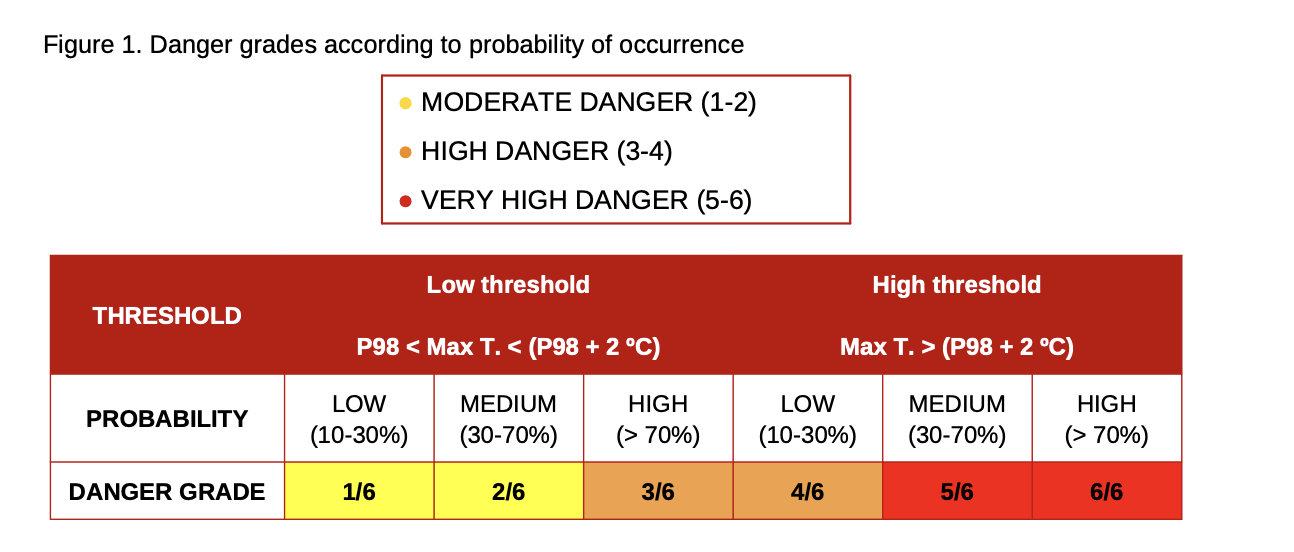
Objective 1 – Early prediction. Diurnal and nocturnal maximums and minimums temperature and humidity are collected for ten cities (Barcelona, l’Hospitalet de Llobregat, Manresa, Mataró, Santa Coloma de Gramenet, Sabadell, Terrassa, Girona, Lleida, Tarragona), along with 48-hour forecasts. Forecasts are assessed against a six-grade Dangerous Meteorological Situation scale (Situació Meteorològica de Perill or SMP):
Grades 1–3 (low threshold): focuses on the probability of temperature exceeding the 98th percentile of the daily maximum temperature for that summer period (June to September)
Grades 4–6 (high threshold): focuses on the probability of temperature exceeding the 98th percentile of the daily minimum temperature for that summer period (June to September) by 2 degrees celsius.
Warnings can be activated or deactivated independently by county.
Alongside forecasting, the plan runs monitoring of hospital admissions and mortality throughout Catalonia, and clinical diagnosis related to heat waves both at health care centers and hospitals. The plan also coordinates with Spain’s national Ministry of Health under the national heat prevention plan.
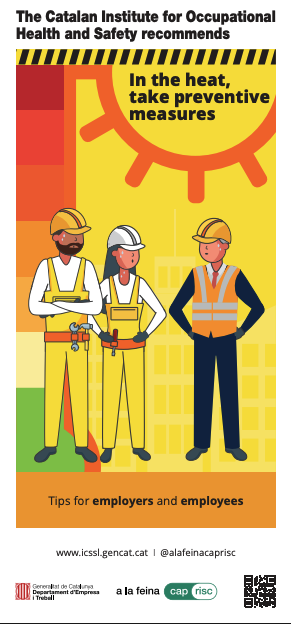
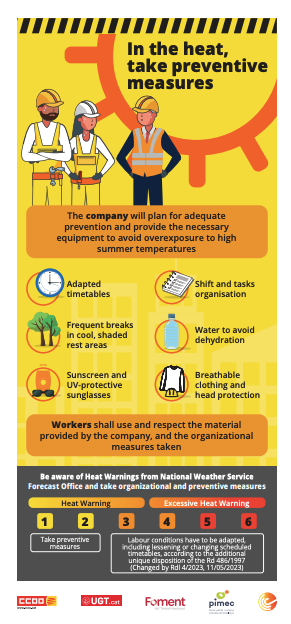
Objective 2 – Minimising health effects of intense heat on the population Catalonia; especially the most vulnerable. This covers: public communication (web guidance, posters in Catalan, Aranese, and Spanish, a short video for waiting rooms and public screens), the 061 CatSalut Respon phone line for public queries and dispatch, guidance for elder and disability care services, workplace heat guidance from the Catalan Institute for Occupational Safety and Health (leaflets, UV exposure infographics, updated web guidance, distribution through workers’ mutual insurance associations, and analysis of heat-related workplace accidents), clinical guidance for primary care, mental health, and hospital staff on recognising heat stroke and related conditions, and the upkeep of registries of frail residents held jointly by municipalities, primary care centres, and social services.
Objective 3 – Coordination. ASPCAT and CatSalut coordinate the full network of participating bodies through a pre-heat season planning meeting, an annual review of the plan, and further meetings as needed, particularly once very intense heat is underway. The plan coordinates the resources of over 15 participating entities. To ensure proper coordination and follow up, a technical group is tasked with evaluating the overall impact of measures taken during that season and use that information to make recommendations for the following year.
Timeline & Evolution
In direct response to the 2003 European heatwave’s mortality and hospital admission spike in Catalonia, the Public Health Agency of Catalonia (ASPCAT) launched an Action Plan to Prevent the Effects of Heatwaves on Health (POCS) on May 26, 2004. It has been ongoing since its launch in 2004.
After the deployment of this plan, Response times and operational activation structures in heat emergency plans have shifted from slow, static, and reactive triggers to rapid, automated, and impact-based forecasting.
More recently, since 2023, Night-time heat alerts have been operationalized in order to warn residents when temperatures do not fall below 20 °C, 25 °C or 30 °C.
This trend continues currently, as the response system is now embedded year-round, so frontline social care, transport, and utilities trigger mitigation steps proactively instead of reactively.
Actors & Governance
The plan is led by the Public Health Agency of Catalonia together with the Catalan Health Service (CatSalut). Participants also include over 15 entities:
Department of Labour, Social Affairs and Families;
Department of Interior;
Meteorological Service of Catalonia (SMC);
Emergency Medical System (SEM);
Catalan Health Institute (ICS);
Barcelona Public Health Agency (ASPB);
Barcelona Provincial Council Public Health Service;
Catalan Association of Municipalities;
Federation of Municipalities of Catalonia;
Council of Pharmacist Colleges of Catalonia;
Institute of Legal Medicine and Forensic Sciences of Catalonia;
Catalan Health and Social Consortium;
Catalan Hospitals Union;
Barcelona Social Services Consortium;
Red Cross;
Catalan Epidemiological Surveillance Network.
POCS operates as an annual operational health plan, activating as the health-sector arm alongside Pla Territorial de Protecció Civil de Catalunya (PROCICAT), during a confirmed heatwave. It also aligns with the National Plan for Extreme Heat Risk with Spain’s national Ministry of Health View source ↗
Implementation Considerations
Trigger mechanism: The six-grade SMP scale ties action directly to forecast confidence and the local 98th percentile summer maximum temperature, rather than a single fixed temperature.
Geographic flexibility: Warnings apply per comarca (county), so one part of Catalonia can be under alert while another is not.
Data dependencies: Requires standing daily data feeds from meteorological, hospital, judicial, and epidemiological sources across multiple agencies. This is a sustained inter-agency monitoring commitment rather than a one-off system.
Maintenance: A pre-season meeting resets the plan each year and reviews the prior season’s performance.
Co-Benefits
Co-benefits: The occupational health strand (Catalan Institute for Occupational Safety and Health guidance) extends heat protection into workplace injury prevention, separate from the direct public health aims. The coordination structure also feeds directly into Catalonia’s wider civil protection response (PROCICAT), so the health monitoring built for POCS strengthens emergency response more broadly.
Equity Considerations
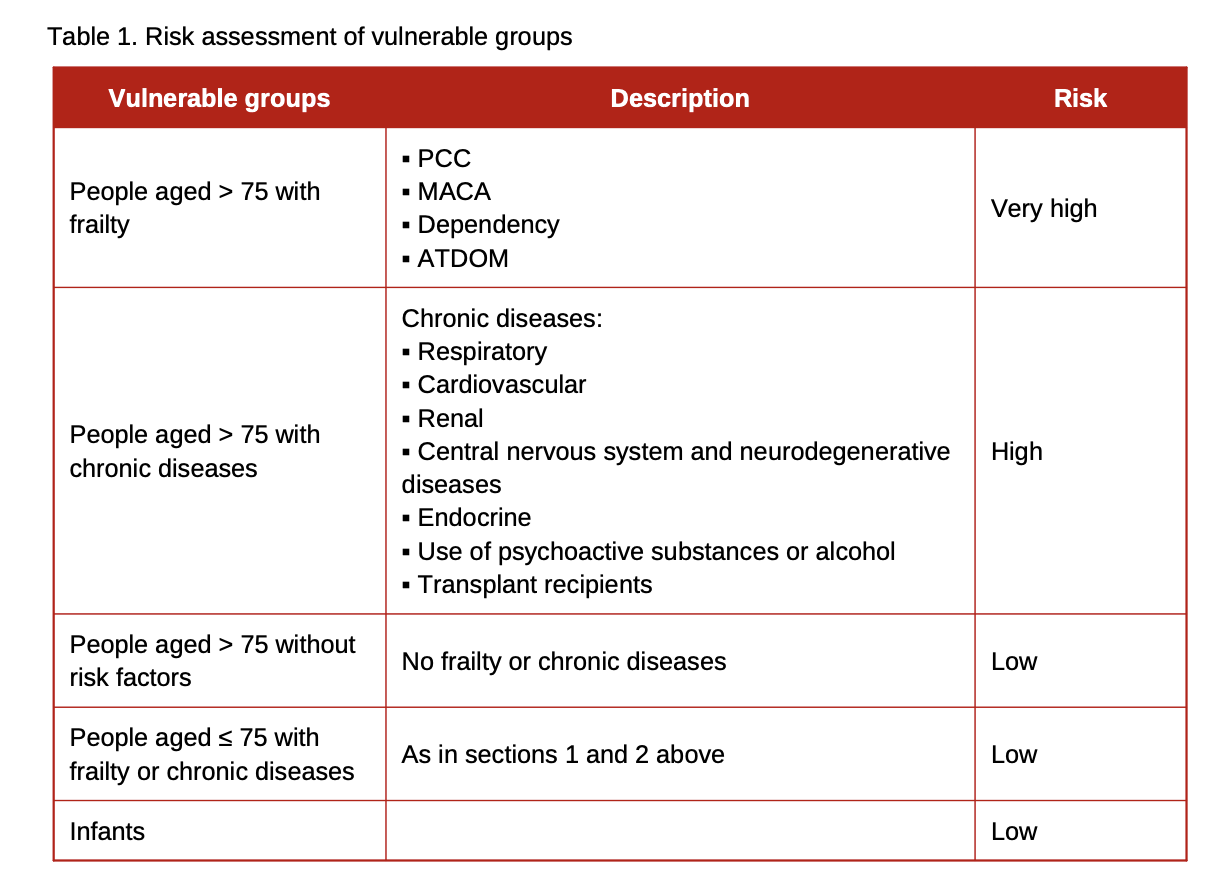
Under Objective 2 of the Action plan, specific vulnerable groups are named throughout:
- People over the age of 75
- Infants
- People with physical or psychological disabilities that limit self-care
- People with chronic illness
- Frail people living alone
- People in precarious social circumstances (unhoused)
Impact & Evidence
The development and delivery of POCS has enabled Catalonia to set out a coordinated and effective response to heatwaves. It has also enabled the development of specific plans for more specific departments across the regional government.
According to the 2023 Actions carried out under the Action Plan to Prevent the Effects of Heat, the use of hospital emergency departments was 4% lower among those contacted by health systems as a prioritized action under POCS as opposed to uncontacted groups. There was also a 1% decrease in the number of people who needed hospital admissions this year in comparison to those uncontacted through the POCS program.
Best Practice Principles
Annual preparation. Annual updates to a heatwave response plan and coordination of key agencies to prepare for heat seasons.
Locally focused alerts. A graded, probability-based warning scale tied to local percentile thresholds, rather than a single absolute temperature trigger.
Multiphased seasonal-based plan. A three-phase seasonal structure (preparatory, active monitoring, alert) that scales response effort to actual risk rather than running at full intensity all summer.
Health Data Coordination from various sources. Pooling mortality signals from multiple independent sources ( hospitals, judicial/forensic records) to catch heat deaths that might not otherwise be flagged quickly.
Cross-Departmental Registries of Vulnerable Groups. Standing registries of frail residents shared across health and social services ahead of the season, so outreach during an alert does not start from zero.
Next Steps
Catalonia is continuing to ensure current technical efforts are focused on selecting specific impact and outcome indicators that allow for a precise determination of both the impact of heatwaves and the effectiveness of the measures implemented.