Key Information
| Title | Cooler Places Guidance |
| Hazard | Heat |
| Region and Country | New South Wales, Australia |
| Action Type | Technical Tool / Guidance |
| Further Categorisation | Cooling the Built Environment Planning Guidance / Framework Supports others in the state to take action |
| Guidance | Find the Cooler Places Guidance Here |
Video explainer
Context
The State of New South Wales (NSW) in Australia is taking action to address increasing heat risk in urban environments. Built up, urban areas are a source of heat risk. Cities heat up faster and stay hotter than their surrounding areas because of how they are built. Less space for nature, dense development, dark surfaces and materials that retain and release heat create hot places. However, urban spaces also present an opportunity to build resilience to higher temperatures and create cooler places.
Mitigating the impacts of extreme heat in urban landscapes through statutory planning requirements is a critical action to build resilience to rapidly heating conditions across regions with mediterranean climate types. It can ensure that we are not locking in future heat risk by continuing to build places that are unsuited to higher temperatures and exacerbate community vulnerability without integrating thermal resilience considerations. However, amending planning requirements is complex and can have a long lead time to impact, from the development of sound planning requirementsto their official introduction and implementation on the ground. Introducing clear guidance is a useful stepping stone which can influence the built environment, support development of industry and community capability and build resilience to extreme heat.
Further, many different stakeholders play a role in the development and construction of buildings and places.
Action Description
Cooler Places is a publicly accessible online resource developed by the NSW Department of Planning, Housing and Infrastructure. It provides practical guidance on four design interventions for cooling urban environments:
- urban structure (street orientation, building layout, shading),
- greening (tree canopy, green roofs, green walls),
- water (permeable surfaces, water features, stormwater irrigation), and
- cool materials (high-albedo roofing, light-coloured paving).
Take action with urban structure
Take action with cool materials
Cooler Places is intended for a broad audience – town planners, urban designers, developers, councils and the community – to support them to reduce urban heat. The guidance works at a range of levels.
- Individuals who are taking on building projects
- Councils developing strategic plans and planning controls
- Developers bringing forward projects
- Community and homeowners
The guidance is deliberately principles-based rather than prescriptive. This allows it to support local adaptation across NSW’s varied climate conditions, settlement densities, and community contexts, while building familiarity and capacity among the people responsible for planning and design decisions. It targets town planners, urban designers, developers, councils, and homeowners.
Guidance is specific enough to drive action. It gives direction such as orienting buildings to capture prevailing breezes and reduce east and west facing exposure, while leaving room for professional judgement on how to apply this to a given site. It also links users to further tools, including the state’s BASIX thermal performance method.
Government-led projects have applied the design interventions directly. Landcom’s Rouse Hill town centre project and the Bradfield Development Authority’s Bradfield City Centre Master Plan and First Building are both cited on Cooler Places as case studies of the guidance in practice.
Timeline and Evolution
Cooler Places was delivered as a 100-day election commitment following the 2023 NSW State Election, when the incoming Minister for Planning committed to producing a resource to address urban heat. At the time, the NSW planning system provided limited guidance on the issue.
Cross sector interest in action to address urban heat supported the delivery of this action, including the work of the Greater Sydney Heat Task Force, sustained media coverage and research published by NSW’s Universities.
The four pillars of urban cooling set out by the guidance were informed by a range of existing resources and guidance, drawn together through internal consultation. This work built the capacity of the State’s Planning department on action to mitigate urban heat.
Cooler Places was developed in-house by three to four NSW Department of Planning staff over a period of a few months. Harnessing internal resources has built capacity within the team and wider department, increasing ability to provide advice on applying the guidance.
Ongoing resourcing is required to maintain and update the guidance as practice evolves. The Department has confirmed plans to regularly update content, links, and case studies.
Development commenced: 2023
Publication of Guidance: 2023
Staffing: 3-4 staff from the department of planning worked on the development and completion of the guidance supported by colleagues from other departments.
Next Steps: In early 2026 the State Government consulted on introducing consideration of heat into Planning Policy.
The introduction of the guidance is a key step in moving to legislated requirements to consider urban heat through the planning system. The guidance has built the capacity of the State’s planning department, as well as practitioners across the state.
Actors & Governance
Development involved internal consultation with a range of stakeholders within the state government, more local units of government, academia, and industry specific bodies. This includes: Government Architect NSW and other parts of DPHI, Sydney Water, the Western Sydney Regional Organisation of Councils, the NSW Department of Climate Change, Energy, Environment and Water, and Landcom.
The Department’s communications and digital teams played a significant role in designing and building the resource.
Within the NSW planning hierarchy, legislation sits above plans, policies, and guidance. Cooler Places sits at the guidance level and functions as best practice advice that can be applied alongside legal planning requirements. It is voluntary and not currently enforced.
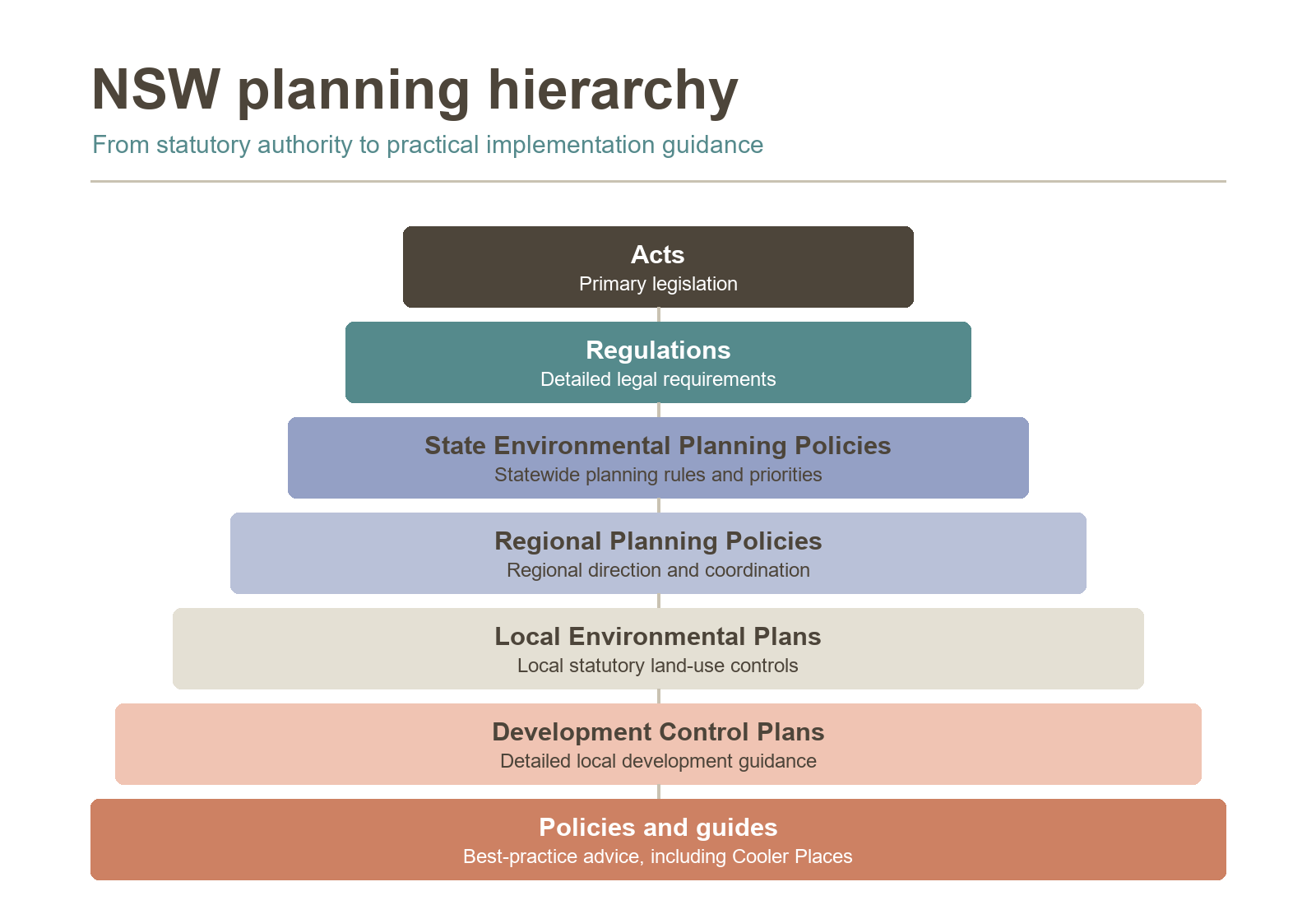
https://www.bmcc.nsw.gov.au/development/planning-rules/state-and-regional-environmental-plans
Cooler Places also supports the recommendations of the Greater Sydney Heat Taskforce, a cross-sector body of state and local government, health, infrastructure, emergency management, and community organisations. The Taskforce produced the Heat Smart City Plan in December 2025, setting out 40 recommendations across six strategic directions, developed with input from over 40 organisations and 373 individuals.
Implementation Considerations
The guidance was built in-house by the Department of Planning, Housing and Infrastructure’s resilience and sustainability division. Subject matter expertise was brought in from partner organisations across the state as required.
The team identified several barriers and challenges during development:
- The team did not hold all the technical expertise needed to cover such a broad range of topics in-house and had to bring in subject matter experts from across government.
- Finding the right level of detail for a broad, non-technical audience was an ongoing challenge, requiring several rounds of rewriting.
- Structuring the website so different audiences (planners, developers, homeowners) could source relevant content with generalised technical guidance in collaboration with the Department’s digital team.
Costs and resourcing
3-4 full-time staff worked to develop and deliver this through 2023.
This project did not have a dedicated budget line, this project was delivered as a business-as-usual scope of the Greener and Sustainable Cities branch.
Co-Benefits and Trade-Offs
Supporting the full range of actors who shape the built environment to deliver cooler places has potential co-benefits including increased green space, biodiversity, amenity, and healthier places. It also builds internal government capacity and signals a system-wide priority on heat resilience ahead of formal regulation.
Trade-offs: low. Introducing guidance is a low-risk action. It builds awareness in a growing climate change space in planning, and provides a baseline in expanding future system capacity.
Equity Considerations
The Cooler Places Guidance can be applied to a range of settings and does not include spatial or distributional targeting in its guidance content. However, the wider NSW urban heat programme is underpinned by equity-relevant data. In 2023 the NSW Government published the Greater Sydney Region Tree Canopy dataset, and it also commissioned a Heat Vulnerability Index for Greater Sydney from RMIT, mapping the distribution of heat-vulnerable communities and the social, built-environment, and demographic drivers behind that vulnerability. This data highlights areas for spatially targeted investment and prioritisation where the guidance of Cooler Places can be utilised in planning for climate-resilient design.
Cooler Places Guidance can be applied by local authorities with responsibility for local land use planning and planning decisions. Action to build resilience to heat through new developments or redevelopment can be prioritised using heat-equity data pointing where heat risk is highest, and where communities face underinvestment and lower adaptive capacity.
Impact and Evidence
The Cooler Places webpage has significant web traffic with over 12,829 visits as of July 31, 2026. This number is projected to increase with the delivery of Urban Heat policies and guidance as Cooler Places remains one of the implementation tools to support the broader initiatives of heat mitigation in NSW.
The guidance has informed the local plans of several councils in greater Sydney and supported councils to introduce planning controls with urban heat mitigation as a primary objective.
The Guidance has been applied to NSW State Government-led projects, including Rouse Hill town centre and the Bradfield City Centre Master Plan and First Building.
Key Learnings from Delivery
Engage early with relevant subject matter experts across government and industry, such as water, urban design, and greening specialists, to shape scope, content, case studies, and the right level of technical detail for the local context.
Draw on existing resources and guidance material already available in-country or in-state rather than starting from nothing.
Best Practice Principles
Voluntary guidance can be used deliberately to build capacity and signal direction ahead of moving to mandatory regulation, rather than waiting for legislation to lead.
An ecosystem approach, engaging the full range of actors who influence the built environment, extends the reach of a single guidance document beyond what any one regulator could mandate directly.
Guidance that names concrete, specific interventions is more actionable for practitioners than general direction, even where it remains non-binding.
Building this kind of resource in-house, even where technical capacity is challenged, can generate lasting internal capability that outsourcing would not.
Next Steps
The Department is proposing to embed design principles from Cooler Places into statutory considerations at the rezoning and development assessment stages, through the proposed Climate Change and Natural Hazards State Environmental Planning Policy (SEPP).
This change would recognise urban heat as a specific climate impact that planning and consent authorities will need to consider under planning legislation, including by reference to the (currently in draft) NSW Urban Heat Policy for Land Use Planning. The Climate Change SEPP is proposed to contain outcomes-based provisions and triggers that apply to certain developments. For example, the provisions may require consideration as to whether the development contributes to cooling the local environment and supports community health and wellbeing in ways that are proportionate to the size and complexity of the development.
This would move urban cooling and heat mitigation from optional guidelines, to mandatory statutory considerations during the rezoning (plan making) and development assessment stages.
The Department also plans to regularly update Cooler Places with new content, links, and case studies, rather than treating it as a static resource.