Key Information
| Title | Seawater and Brackish Water Desalination Plants |
| Hazard | Drought |
| Region and Country | Maroc Oriental, Morocco |
| Action Type | Infrastructure investment and delivery |
| Further Categorisation | Water supply infrastructure |
Context
This action responds to drinking water supply pressure across the provinces of the Oriental region, within a national context of severe water scarcity and prolonged drought. Water scarcity constrains Morocco’s economy. National water availability fell from about 2,560 m³ to about 620 m³ per person per year between 1960 and 2020. Population growth was the main cause, compounded by lower rainfall and higher temperatures. National demand is projected to rise by 15 percent between 2020 and 2050.
Rainfall has fallen by 20 percent over the past three decades, lowering both groundwater and surface water levels. Morocco experienced a succession of drought years between 2018 and 2025. The Moulouya hydraulic basin in north-eastern Morocco is vital to the water supply of many of the Oriental’s provinces. Groundwater in the basin is abstracted faster than it is replenished, and its aquifers are overused by 100 percent. The region is an agricultural and economic hub, and water stress has a direct impact on economic development and local livelihoods.
Desalination removes salts and minerals from seawater or brackish water to produce drinking water. Morocco is expanding desalination alongside demand management. Installed desalination capacity stood at 220 million m³ per year at the end of 2022. This was less than 2 percent of all mobilised water resources, with 44 percent of desalinated water going to drinking water supply. By 2026, Morocco had 17 operational seawater desalination plants with a combined capacity of 350 million m³ per year.
Action Description
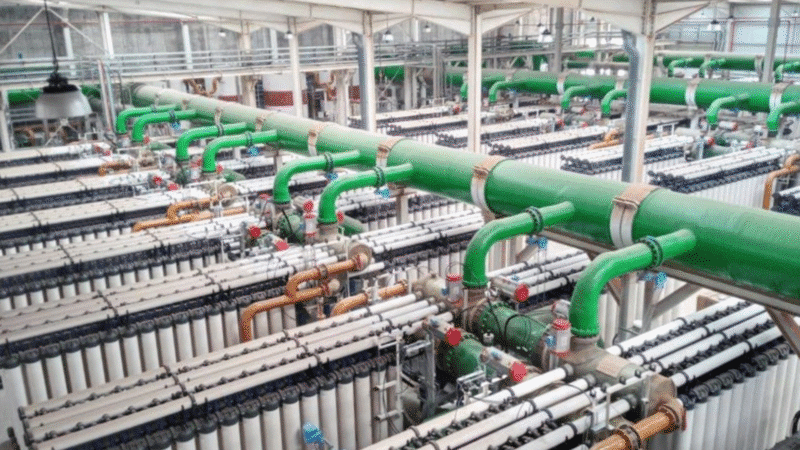
This action delivers decentralised desalination and brackish water treatment across the Oriental region to strengthen drinking water security. It builds small, self-contained treatment units (monobloc stations) that turn saline groundwater and seawater into drinking water for local supply networks. The Société Régionale Multiservices de l’Oriental (SRM-Oriental), the region’s multiservice utility, operates the facilities.
The action forms part of the national emergency programme for building seawater and brackish water desalination units to secure drinking water supply. The Ministry of the Interior and the Regional Council of the Oriental implement that programme in the region through an agreement adopted on 17 April 2024.
Brackish water treatment
The action builds 8 brackish water desalination plants in the provinces of Driouch, Figuig, Guercif, Jerada and Nador.
Example: The mobile demineralisation unit at Oued El Himer, in Tiouli commune, Jerada province, works as follows:
- It draws saline groundwater and treats it by pretreatment followed by reverse osmosis.
- It pipes the treated water to a distribution tank linked to the local supply network.
- It produces 3 litres per second of drinking water.
- Power reaches the unit through an electrical transformer.
Seawater desalination
The action connects 3 seawater desalination plants in the provinces of Berkane and Nador to the water and electricity networks.
Regional operation through SRM-Oriental
SRM-Oriental is a publicly owned company created under Law 83.21. It is the region’s single operator for drinking water, electricity and sanitation distribution. It takes over these services from the National Office of Electricity and Drinking Water (ONEE) and the autonomous municipal utilities (régies), as part of water sector reform in Morocco. It works under a 30-year management contract with the grouping of the region’s municipalities, which holds the distribution concession.
SRM-Oriental contracts out the management and operation of the treatment facilities through a public tender with five provincial lots: Nador, Driouch, Guercif, Figuig and Jerada.
Timeline & Evolution
The action was agreed in April 2024 and is in early delivery. The first documented unit began operating in July 2026.
The action originates in the national emergency programme to build seawater and brackish water desalination units and secure drinking water supply (programme d’urgence de construction d’unités de dessalement de l’eau de mer et des eaux saumâtres au niveau national). Its operating model originates in Law 83.21 on regional multiservice companies, published on 17 July 2023. A decree published in February 2024 gave the Oriental and three other regions four months to create their companies, as the first phase of the reform.
On 17 April 2024, the Regional Council of the Oriental held an extraordinary session in Oujda. It adopted the desalination agreement with the Ministry of the Interior at that session. It also approved joining SRM-Oriental and adopted the company’s statutes and shareholders’ charter. By July 2024, SRM-Oriental had been created as the first regional multiservice company in Morocco. It began operating as the region’s single distributor of drinking water, electricity and sanitation on 15 November 2024.
On 12 April 2026, SRM-Oriental published a tender for the management and operation of the monobloc desalination and demineralisation stations, in five provincial lots. A second tender covers a study of drinking water supply from the monobloc stations (Étude d’alimentation en eau potable à partir des stations monobloc de déminéralisation et de dessalement).
In July 2026, the mobile demineralisation unit at Oued El Himer, Tiouli commune, began operating.
Actors & Governance
The Regional Council of the Oriental (Conseil de la Région de l’Oriental) owns this action. The Regional Council is the elected regional government of the Oriental. It co-finances the action and is signatory to the agreement with the Ministry of the Interior that establishes it.
The Council works in partnership with Morocco’s central government through the Ministry of the Interior. The Ministry designed the national emergency programme for monobloc desalination and demineralisation stations, and it led the national roll-out of the regional multiservice companies.
SRM-Oriental, the regional utility, is responsible for delivering the action. It oversaw delivery of the Tiouli unit and contracts out the management and operation of the treatment facilities.
The national emergency programme
The Ministry of the Interior’s national programme provides for 203 monobloc desalination and mobile demineralisation stations across Morocco’s 12 regions. It also provides for connecting existing stations to the public water and electricity networks. The programme sits within the National Programme for Drinking Water Supply and Irrigation 2020–2027.
The Ministry designated the Régie Autonome Multiservices d’Agadir (RAMSA), the Agadir water and electricity utility, as delegated project owner for building the 203 stations. RAMSA has since been absorbed into SRM Souss-Massa, which leads the programme under Ministry of the Interior supervision.
Ownership and control of SRM-Oriental
SRM-Oriental has a capital of 100 million dirhams. The shareholding is as follows:
- The State holds 25 percent.
- The Groupement des communes de l’Oriental pour la distribution holds 40 percent. The Groupement is the grouping of the region’s municipalities that holds the distribution concession.
- The Regional Council holds 10 percent.
- ONEE, the national public utility for electricity and drinking water, holds 25 percent.
The company’s board is chaired by the Wali of the Oriental, who represents central government in the region.
Regionalisation and water sector reform
The action sits within Morocco’s policy of advanced regionalisation. Article 143 of the 2011 Constitution gives regions a leading role, alongside other local authorities, in preparing, implementing and monitoring regional development programmes and regional spatial planning. Regions can set up Local Development Companies. These are local public companies whose capital local authorities control, and they deliver regional infrastructure and equipment.
Law 83.21 provides for a regional multiservice company in each of Morocco’s 12 regions, created in phases. The water sector reform separates bulk water and energy production, which a national operator handles, from distribution and wastewater services, which are entrusted to the regional multiservice companies.
Implementation Considerations
SRM-Oriental implements the action by contracting out the management and operation of the treatment facilities through a public tender with five provincial lots: Nador, Driouch, Guercif, Figuig and Jerada. The tender, reference 10006899, was published on 12 April 2026 on Morocco’s public procurement portal, marchespublics.gov.ma, which handles the tender documents and electronic bids.
Desalination forms one part of an overarching water supply strategy and domestic water use approach. Morocco’s national programme pairs new supply with:
- targets for reducing water losses
- incentives for water savings across agriculture, drinking water, tourism and industry
- a communication strategy on water conservation
Installation of the Tiouli unit covered five elements:
- the mobile treatment unit
- pipes carrying raw and treated water
- ancillary structures
- connection to the distribution tank
- a power supply through an electrical transformer
Desalination is energy-intensive. Morocco plans to tie new desalination plants to wind and solar developments to reduce operating costs and carbon emissions. The World Bank’s Morocco Water Security and Resilience Program supports the development of desalination regulations, including provisions that limit greenhouse gas emissions by promoting renewable energy. The Tiouli unit draws power from the electricity grid through a transformer.
Seawater desalination costs 1.5 to 4 times more than many traditional freshwater sources and remains too expensive for broad-scale irrigated agriculture. This assessment comes from the International Water Management Institute’s regional representative for the Middle East and North Africa.
Cost & Resourcing
This action requires capital expenditure, institutional capacity and skilled labour. The Region provides initial capital expenditure. Once built, the treatment facilities are run by SRM-Oriental, which contracts out their management and operation through its own procurement.
The Regional Council allocated an estimated 106 million dirhams in 2024 to the action. The allocation covers the construction of 8 brackish water desalination plants and the connection of 3 seawater desalination plants to the water and electricity networks.
Example: The mobile demineralisation unit at Tiouli cost about 8.5 million dirhams. The State financed 70 percent and the Regional Council 30 percent.
The management and operation of the treatment facilities is estimated at 11,945,284.80 dirhams including tax, across the five lots in SRM-Oriental’s April 2026 tender.
At national level, the programme of 203 monobloc stations carries an overall investment of about 2.25 billion dirhams across all 12 regions.
Co-Benefits & Trade-Offs
Co-benefits
Access to services across the region: The regional multiservice company reform aims to extend access to water, electricity and sanitation services across the region and to reduce regional disparities. Placing treatment units in five provinces, including small centres such as Oued El Himer in Jerada province, extends drinking water supply beyond the region’s main networks.
Domestic industrial capacity: Moroccan firms design, build and supply monobloc units. A consortium of WATEC and Schiele Maroc was mandated to deliver the 203 stations of the national programme. A station in Youssoufia province was designed and built by Moroccan firms and engineers from planning to manufacture.
Trade-offs
Cost of desalinated water: Desalinated water costs more to produce than water from traditional sources, which raises the cost of supply for regional and national government. This creates tension between the price of water, service quality and public need. Water tariffs do not currently reflect the costs of water provision and distribution.
Brine discharge: Seawater desalination discharges brine that raises salinity around outfalls and harms marine organisms and biodiversity. Brine from inland brackish water treatment can affect freshwater systems and soils. The discharge also carries treatment chemicals. Brine and chemical discharge need environmental management to avoid maladaptation.
Operating cost and energy use: Desalination and demineralisation carry high, energy-dependent operating costs. Powering units from renewable energy reduces emissions.
Equity Considerations
The action extends drinking water supply to small and dispersed centres across five provinces of the Oriental. This widens the population that the region’s water system can serve. Nationally, the monobloc station programme is directed at securing drinking water for rural localities.
SRM-Oriental was set up to extend access to essential services and to ensure territorial equity between urban and rural areas. The wider reform aims to reduce regional disparities in water, electricity and sanitation services.
Gender
Morocco’s water sector has formal gender commitments:
- Water Law 36-15 (2016) sets a gender approach, covering equitable access to water for women and men and equal participation in decision-making.
- The 2017 Strategy for Gender Mainstreaming in the Water Sector aims to build institutional capacity for gender equality, including by increasing women’s representation in decision-making and technical roles.
- The National Programme for Drinking Water Supply and Irrigation 2020–2027 recognises women’s participation and workplace gender equity.
- Gender-responsive budgeting is in use.
Best Practice Principles
- Desalination works as one part of an overarching water supply strategy and domestic water use approach, alongside targets for reducing water losses and incentives for water savings.
- Regional management of water distribution allows localised responses to supply-stressed places within a region or territory.
- Small modular desalination units can be sited across many dispersed centres, including small communes, to extend drinking water supply across a wide territory.
- Energy supply and brine management need planning alongside treatment capacity, because desalination is energy-intensive and discharges concentrated salt.