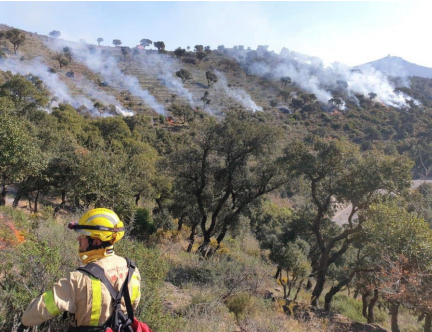
Photo credit: Prescribed burn in cork oak forest near Cap de Creus, Source:
//interior.gencat.cat/web/.content/home/030_arees_dactuacio/bombers/foc_forestal/programa_de_cremes_prescrites/Dades_i_divulgacio/2021_Campanya_cremes_prescrites_hivern_2020-21_EN.pdf Source ↗
SHORT SOLUTION · WILDFIRE MANAGEMENT
Key information
| Title | Integrated Prescribed Burning and Strategic Management Points (PEGs) Model |
| Region and Country | Catalonia, Spain |
| Hazard | Wildfire |
| Action Type | Governance Instrument / Operational Landscape Planning |
| Maturity | Established (operational deployment since 1999) |
| Strategy or Guiding Policy | The PEGs model emerged in the 90s to 2000s as a solution to the large wildfires caused by crown fires, a result of fire exclusion methodology. the Catalonia Fire Service is moving away from fire exclusion to the core principals of the PEGs Model. |
| Key links | Prevention of Large Wildfires Using the Fire Types Concept Empowering Strategic Decision Making for Wildfire Management: avoiding the fear trap and creating a resilient landscape International Association of Wildland Fire, Overview 2024: Catalonia- Understanding the Fire Generation Concept The Path to Strategic Fire Management Planning in the Aran, Pyrenees |
Action Description
Catalonia’s wildfire resilience strategy combines landscape-scale fuel management with tactical fire suppression capabilities. It is based on two core pillars:
Strategic Corridors and Strategic Management Points (PEGs): Critical locations identified through fire behaviour analysis, where vegetation management — including agricultural practices, thinning, grazing and prescribed burning — can help reduce fuel continuity and create safer opportunities for firefighting operations during large wildfire events.
Prescribed Burning Framework: The systematic use of controlled burns by specialised firefighting crews (GRAF) to manage fuel loads, maintain strategic areas, support the restoration of natural fire regimes and train operational personnel in fire behaviour under controlled conditions.
Who in regional government delivers this
GRAF (Grup de Recolzament d’Actuacions Forestals), a specialized Action Unit within the Catalonian FIre Service (Bombers de la Generalitat de Catalunya).
Impacts
Operational Efficacy: In March 2023, an unplanned wildfire occurred in Canejan, the fire burned 327 hectares over 14 days, which was successfully contained within a pre-planned manageable area of 346 hectares. This fire required the same amount of staff needed during a smaller 30 hectare planned prescribed fire in Bossot that occurred in February. The GRAF team were also needed to be on site for 4 of the 14 days once the fire had been anchored in the pre-planned area.
Best Practice Principles
Inter-agency coordination: Joint planning involving forest management authorities, the agricultural and livestock sectors, and emergency services to prioritise interventions in high-risk areas and integrate wildfire prevention into landscape management.
Operational effectiveness: The creation of pre-planned strategic locations that can support firefighting operations and help reduce the risks and difficulties associated with suppressing large wildfires, particularly under extreme fire weather conditions.