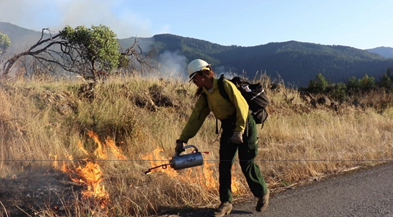
Photo credit: Prescribed Burn conducted by Karuk Tribe Environmental Workforce Development and Internship Coordinator, Source: Jenny Staats
View source ↗
SHORT SOLUTION · CULTURAL FIRE
Key information
| Title | SB 310 Cultural Fire Agreements |
| Region and Country | California, United States of America |
| Hazard | Wildfire |
| Action Type | Governance Instrument (Legislation + Intergovernmental Agreement) |
| Maturity | Bill newly enacted since 2024 |
| Strategy or Guiding Policy | California’s Wildfire and Forest Resilience Action Plan (2021); California’s Strategic Plan for Expanding the Use of Beneficial Fire (2022), Climate Smart Lands Strategy (2022); Nature-Based Solutions Climate Targets (2024); Governor’s Wildfire and Forest Resilience Task Force. Enacted as Senate Bill 310 (Dodd), signed by Governor Newsom, September 2024 |
| Key links | Bill Text: CA SB310 Draft Bill CA SB310 Press Release: Governor Newsom Signs Executive Order to Expand Beneficial Fire Use Wildfire Task Force – Beneficial Fire Webpage |
Action Description
Fuel accumulation, driven by over a century of fire suppression policy, has created landscapes that burn at higher intensity than at any point in the historical record. Climate change is compounding this through drought, heat, and shifting wind patterns that extend fire season and enable larger, faster-moving fires. In many Indigenous territories, suppression of cultural burning has both increased fuel loads and severed traditional ecosystem stewardship relationships, creating a governance gap that neither state nor federal agencies have been able to fill with conventional approaches.
A critical barrier to expanding prescribed fire in California has been legal and regulatory: tribal communities who have practised cultural burning for millennia were prevented from doing so by permitting requirements, air quality regulations, and a lack of formal legal standing to conduct burns on ancestral territories. SB 310 was designed to close this governance gap by creating a formal bilateral legal mechanism between the State and federally recognised tribes.
SB 310 grants authority to the California Natural Resources Agency (CNRA) and local air districts to enter into Cultural Burn Agreements with federally recognised California Native American tribes. These agreements replace the requirement to obtain standard burn permits, honouring tribal sovereignty and recognising cultural burning as a distinct category of fire management. They give tribes the legal standing to conduct burns on ancestral territories outside the standard permitting process, providing a government-to-government framework built on co-management principles. The legislation explicitly acknowledges the historical wrong of criminalising traditional burning practices.
The first Cultural Burn Agreement under SB 310 was executed between the Karuk Tribe and CNRA in February 2025. Following this, the Karuk Tribe and CNRA jointly developed a replicable template agreement for use by other tribes, alongside educational materials to support government-to-government collaboration. CNRA hosted an Advancing Cultural Fire Workshop in April 2025.
The mechanism at the core of SB 310, is a formal intergovernmental agreement that substitutes for and supersedes a permit. Rather than accommodating Indigenous burning within an existing regulatory framework, the legislation creates a parallel legal pathway that formally recognises a distinct, non-state form of fire management. It reframes tribal practitioners from permit applicants subject to state discretion to equal governmental partners operating under sovereign co-management authority. The template agreement is designed for replication across California’s 109 federally recognised tribes.
Who in regional government delivers this
SB 310 grants authority to the California Natural Resources Agency (CNRA) and local air districts to enter into Cultural Burn Agreements with federally recognised California Native American tribes, instituting tribal practitioners as equal governmental partners in delivering traditional burning practices.
Impacts
In 2025, CAL FIRE for the first time met and exceeded its 50,000-acre annual beneficial fire target. California’s Nature-Based Solutions Climate Targets (April 2024) set annual targets for applying beneficial fire to reduce the risk of wildfire, starting with 800,000 acres in 2030, and increasing to 1.5 million acres in 2045. Traditional burning is an integral component in achieving these targets.
Cost/ Funding Source
To protect against possible losses from prescribed and cultural burns that escape control, CAL FIRE created a Prescribed Fire Liability Claims Funds that includes 20 million dollars worth of state funding. An extra level of protection instituted as traditional burning practices are implemented as another mechanism across the state.
Best Practice Principles
Legislate the authority to enter agreements. Granting the state natural resources agency and local air districts explicit statutory power to sign cultural burn agreements gives tribes legal standing to burn on ancestral lands without depending on case-by-case discretion.
Development of Traditional Burning Practices Liability Claims Fund
Replace the permit with a government-to-government agreement. An agreement that substitutes for the standard burn permit treats tribes as governmental partners with their own fire management authority, and recognises cultural burning as a distinct practice outside conventional prescribed fire rules.
Turn the first agreement into a template. Developing a model agreement jointly with the first participating tribe gives other tribes a tested starting point and reduces the time needed to negotiate each new agreement.
Support uptake with guidance and convening. Pairing the template with educational materials and workshops for agency staff and tribes builds shared understanding of cultural burning and of how the agreements work in practice.