Photo credit: View source ↗
SHORT SOLUTION · WILDFIRE PREPAREDNESS
Key information
| Title | Programa Estatal para el Manejo de Fuego (State Forest Fire Prevention and Management Programme) |
| Region and Country | Baja California Sur, Mexico |
| Hazard | Wildfire |
| Action Type | Governance Instrument / Multi Agency Coordination |
| Strategy or Guiding Policy | Baja California Sur’s Fire management strategy originates from Mexico’s General Law of Sustainable Forest Development (Ley General de Desarrollo Forestal Sustentable, LGDFS), which requires each state to create own fire management strategy and Sistema Nacional de Protección Civil (SINAPROC). |
| Key links | Press Release: //www.bcs.gob.mx/coordinan-autoridades-de-proteccion-civil-inicio-de-temporada-de-incendios-forestales/”>Press Release: “Civil Protection Authorities Coordinate Start of Fire Season” Press Release: //www.bcs.gob.mx/se-prepara-bcs-para-prevenir-y-atender-incendios-forestales-proteccion-civil-estatal/”>Press Release: “Baja California Sur prepares to prevent and respond to forest fires: State Civil Protection” Press Release: //www.bcs.gob.mx/en-bcs-tres-ordenes-de-gobierno-atienden-programa-estatal-para-el-manejo-de-fuego/”>Press Release: “In Baja California Sur, three levels of government are addressing the state program for fire management.” |
Action Description
The Programa Estatal para el Manejo de Fuego is Baja California Sur’s (BCS) primary governance instrument for forest fire prevention, preparedness, and response. It is structured around annual seasonal activation (the fire season in BCS runs from March to August) and operates through a multi-agency coordination framework that brings together federal, state, and municipal institutions under a unified command structure each year.
Each year at the start of the fire season, a Consejo Estatal (State Council) is installed, composed of federal, state, and municipal institutions, to implement the strategies and actions of the national Programa de Manejo del Fuego through the Sistema Nacional de Protección Civil, with the objective of preventing and reducing situations that put the population at risk.
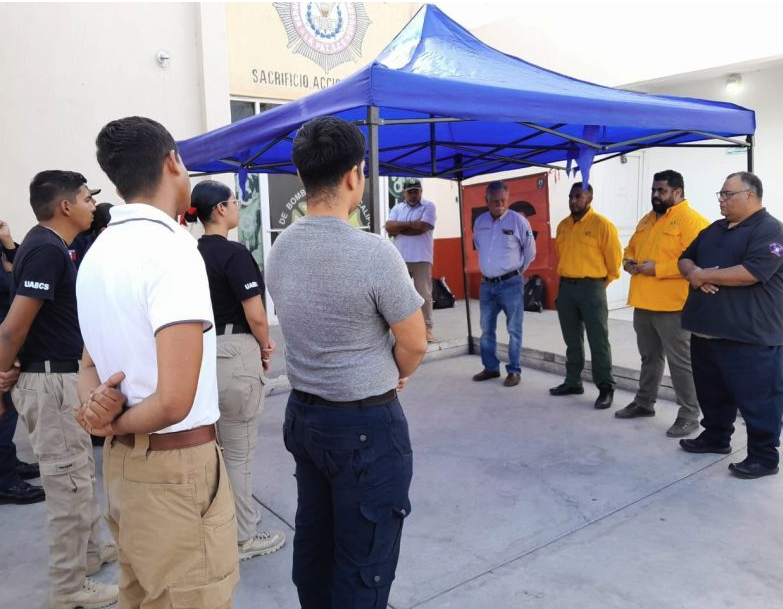
As part of seasonal activation, La Comisión Nacional Forestal (CONAFOR) provides training to personnel from all three orders of government responsible for responding to fire emergencies, formally activating the Equipo Estatal de Manejo de Incidentes (EMI: State Incident Management Team). This activation also strengthens inter-institutional coordination among all agencies involved in wildfire emergencies.
The annual training programme lasts one week and involves personnel from the Secretaría de la Defensa Nacional (SEDENA), the Comisión Nacional de Áreas Naturales Protegidas (CONANP), firefighters (bomberos), state and municipal civil protection bodies, volunteer groups, and students from the Universidad Autónoma de BCS. Activities include simulations, basic fire management courses, and a controlled burn exercise.
Courses cover topics including: activation of incident management teams, the forest fire danger prediction system, fire behaviour, and fire management, combat and organisation.
Equipment and specialist training
CONAFOR and the State Government jointly deliver specialist equipment training for emergency response bodies, including firefighters and state and municipal civil protection personnel. This has included practical courses on portable water pumps and effective water use in fire combat, delivered by specialist brigades from other Mexican states including Jalisco, Sinaloa, Sonora, and Michoacán. The state government’s role is to promote and coordinate this training.
Who in regional government delivers this
CONAFOR provides training to personnel from all three orders of government responsible for responding to fire emergencies. One of these agencies is the Undersecretariat of Civil Protection of BCS (Subsecretaría de Protección Civil de BCS).
Impacts
In 2022, Baja California Sur recorded only six forest fires affecting 90.78 hectares, making it one of the states with the lowest incidents and smallest area affected in the entire country. In 2023, BCS again registered only six fire incidents, with two causing significant impact: one in the community of Todos Santos and one in San José del Cabo. BCS remains one of the entities with the lowest wildfire incidence nationally.
Best Practice Principles
Multiple Agency Coordination Framework: To ensure the success of this framework, agencies must establish a clear system of communication between all levels of governance during emergencies to ensure proper coordination and collaboration.