Photo credit: View source ↗
SHORT SOLUTION · CROSS-JURISDICTIONAL WILDFIRE MANAGEMENT
Key information
| Title | Building Agreements to Streamline Wildfire Management Across Jurisdictions and Land Ownership |
| Region and Country | California, United States |
| Hazard | Wildfire |
| Action Type | Governance Arrangement |
| Strategy or Guiding Policy | California’s Wildfire and Forest Resilience Action Plan (January 2021), Action 1.4 “Expand Agreements”. |
| Key links | Action 1.4 Expand Agreements, California Wildfire and Forest Resilience Task Force U.S. Forest Service Establish Shared Long-Term Strategy to Manage Forests and Rangelands CAL FIRE and BLM Join Forces to Work Across Jurisdictions on Forest and Fuels Management Projects |
Action Description
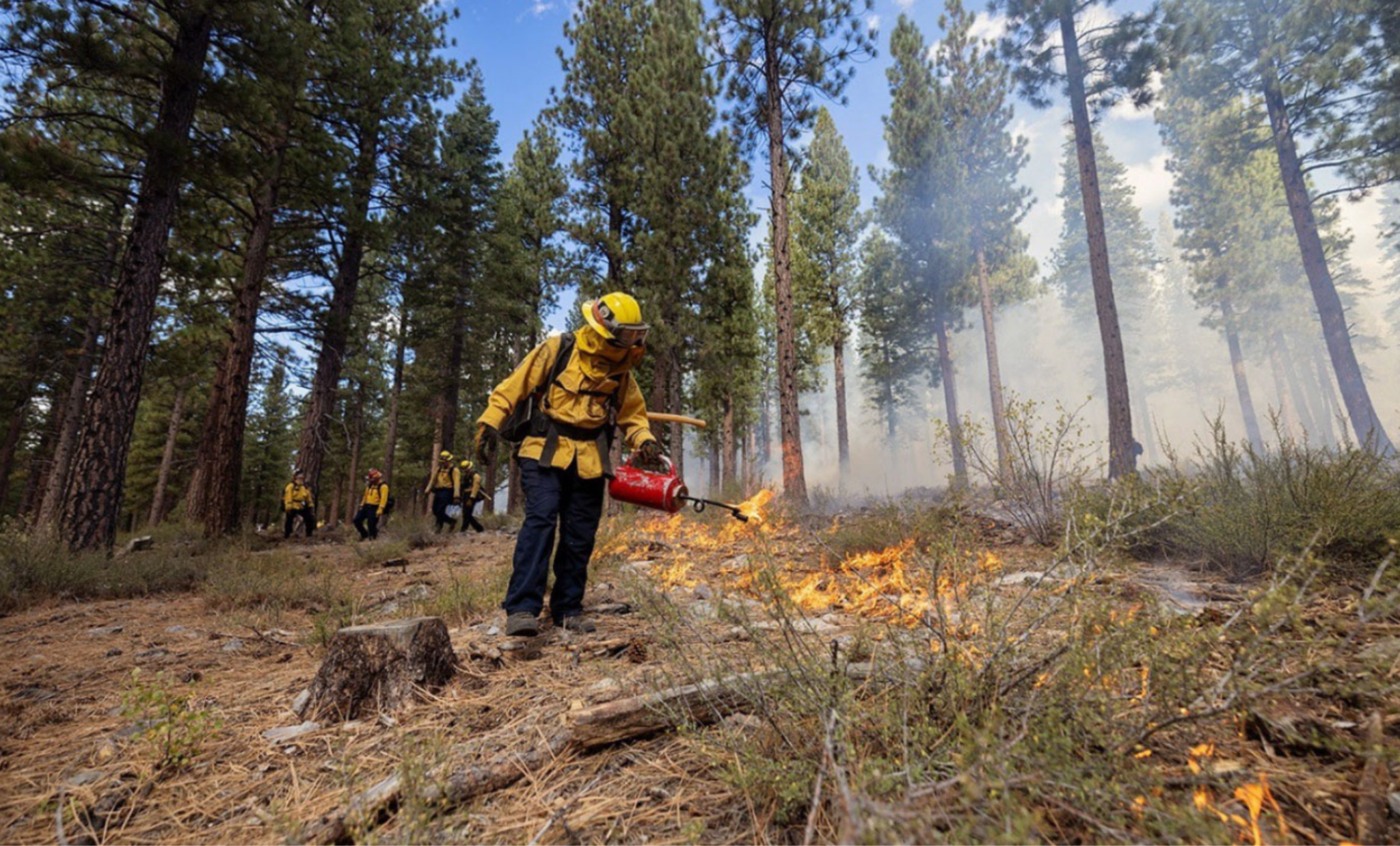
California is strengthening collaboration with state, local and tribal governments in carrying out fuel reduction projects on federal lands. Under Action 1.4 of California’s Wildfire and Forest Resilience Action Plan (January 2021), the US Forest Service (USFS) committed to expand its use of Good Neighbor Authority and Shared Stewardship Agreements and other mechanisms to partner with state, local and tribal governments. These agreements streamline cross-jurisdictional work, allowing CAL FIRE, local agencies and tribal entities to enhance efficiency in planning and implementing treatments that mitigate wildfire risks, improve forest health and build landscape-scale resilience, reducing administrative barriers and aligning management across ownerships.
Vegetation management, mechanical thinning and prescribed fire for fuel reduction are critical to breaking the cycle of catastrophic wildfires. Since more than half of the state’s forested land is under federal ownership, the state cannot act alone. The federal government owns 57% of California’s forest land, mainly managed by the USFS.
The initiative builds on the 2020 Shared Stewardship Agreement between California and the USFS, which set a joint goal of treating 500,000 acres annually by 2025. The agreement, signed in August 2020, sets out six principles and nine actions for state-federal collaboration, including joint project planning and a commitment to share data and invest in science.
Additionally, through the Good Neighbor framework, Caltrans and CAL FIRE have pursued agreements enabling fuels reduction along roads and other federal interfaces. The Good Neighbor Authority, permanently authorised in the 2014 Farm Bill and extended to counties and tribes in 2018, lets these governments act as agents of federal land agencies and use their own procedures and contracting to deliver restoration work on federal land. The California Natural Resources Agency signed a Good Neighbor master agreement with the USFS Pacific Southwest Region in January 2016, under which CAL FIRE and state conservancies hold project agreements on individual national forests. In August 2023, CAL FIRE, Caltrans and the California Conservation Corps signed Good Neighbor agreements with the US Bureau of Land Management (BLM).
Together, these partnerships represent a model of intergovernmental cooperation that aligns resources, uses shared data and accelerates restoration of high-risk lands.
Who in regional government delivers this
The California Natural Resources Agency holds the state’s Good Neighbor master agreement with the USFS, and CAL FIRE, Caltrans and state conservancies carry out work under project agreements. The Task Force’s Forest Management Working Group, chaired by CAL FIRE and the USFS, coordinates the action.
Cost / Funding source
Good Neighbor agreements do not require a transfer of funds from the federal agency, and can be combined with state funding. The 2023 statewide agreement between CAL FIRE and the BLM made about USD 4.5 million available to CAL FIRE.
Best Practice Principles
Use existing federal authority to work on federal land. A legal mechanism that lets state, county and tribal governments act as agents of federal land agencies allows them to deliver fuel treatments on federal land using their own procedures and contracts.
Set a shared treatment target with the main land manager. A signed agreement that commits the state and the largest forest landowner to equal annual treatment targets turns separate programmes into a joint commitment with a common measure.
Agree terms once in a master agreement. A statewide master agreement, with project agreements for individual forests beneath it, sets common terms at the outset so each new project proceeds under an agreed framework.
Name a lead agency and a joint working group for each action. Assigning each action a lead agency and a working group chaired jointly by state and federal agencies makes responsibility for cross-jurisdictional delivery explicit.