Key Information
| Title | Increasing the delivery of Cultural Fire Victoria |
| Hazard | Wildfire |
| Region and Country | Victoria, Australia |
| Action Type | Policy / Governance Instrument |
| Further Categorisation | Indigenous-led land and fire management; fuel and risk reduction |
| Key links | The Victorian Traditional Owner Cultural Fire Strategy Cultural Fire, Forest First Management Victoria |
Context
Victoria is one of the most bushfire-prone regions in the world, and reducing fuel loads on public and private land is central to protecting life, property and the natural environment from bushfire. For tens of thousands of years, Aboriginal peoples in Victoria managed fire-prone land through cultural burning, a practice governed by kinship, Lore and long-held knowledge of Country. European colonisation suppressed this practice, and fire and land management in Victoria shifted to state-led, risk-based approaches focused on protecting life and property, rather than the wider set of cultural purposes cultural burning serves.
A peer-reviewed study of a sediment record from Buchan, on Gunaikurnai Country in Gippsland, found that fire at the site was frequent and low intensity until around 1970. After legislation prohibited the burning that settler landholders had adopted in imitation of Aboriginal practice, woody vegetation increased and catastrophic fires followed. This is one documented example of the link between excluding Indigenous fire management and increased bushfire severity. Source ↗
Traditional Owners in Victoria identify cultural burning as inseparable from their right and obligation to care for Country, independent of any bushfire risk-reduction value.
Action Description
Traditional Owners in the state of Victoria are increasing the delivery of cultural fire across the State. This action is led by Traditional owner groups. The State of Victoria is supporting Traditional Owner-led cultural burning through adaptations to the State’s policy framework, with a long term approach set out in the Victorian Traditional Owner Cultural Fire Strategy (2020) and delivered with the support of Forest Fire Management Victoria (FFMVic) and the Country Fire Authority (CFA), two of the state’s primary fire and land management agencies. Cultural burning is fire deliberately introduced to Country, nominated and delivered by Traditional Owners in partnership with fire agencies, for purposes that include ceremony, protection of cultural sites, regeneration of food and medicinal plants, habitat management, and healing Country. Bushfire fuel reduction is a secondary effect of these burns rather than their primary purpose. Source 1 ↗ Source 2 ↗ Source 3 ↗
The Victorian Traditional Owner Cultural Fire Strategy sets four objectives: developing operational pathways for Traditional Owners to lead burns across all land tenures, building Traditional Owner governance and capacity in Cultural Fire knowledge, improving collaborative management of state forest and private land, and strengthening the institutional frameworks that support Cultural Fire practice. Delivery runs alongside Victoria’s mainstream fuel management system. Cultural burns can be nominated to the state’s Joint Fuel Management Program (JFMP), a three-year rolling plan that coordinates all planned burning on public and private land, and are also delivered outside that program.
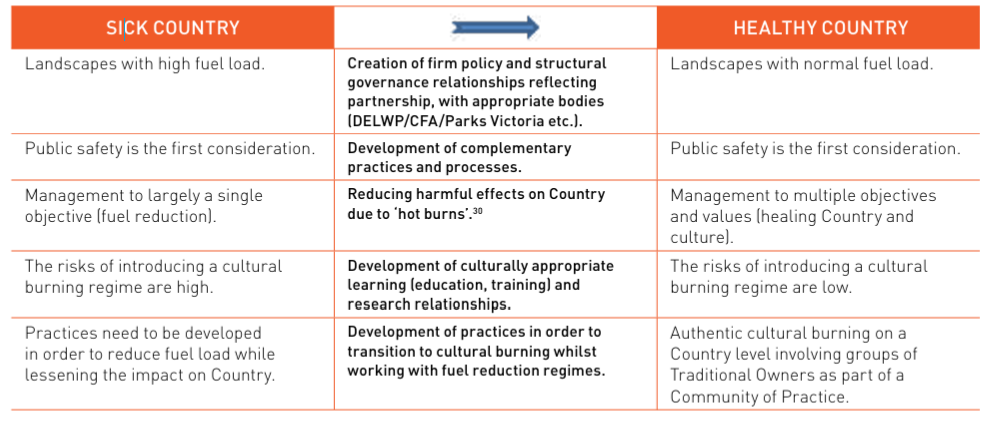
Figure 1. Transitioning to cultural burning in Victoria, Strategy, page 17.
Through the strategy Traditional Owners and the State of Victoria are working to deliver more cultural burns to manage the health of Country- this contributes to healthy and resilience ecosystems in the face of accelerating climate risks in Victoria. 104 cultural burns were nominated to the State’s Joint Fuel Management Program in 2025-2026. This is an approach to adaptive management of land. Source ↗
FFMVic and CFA tailor support to each Traditional Owner Group’s Cultural Fire aspirations and capacity, rather than applying one delivery model statewide. Cultural Burn Officers, now in place in all six regions of the Department of Energy, Environment and Climate Action (DEECA), link government agencies with Traditional Owner Groups on training, self-determination and safe working arrangements. For the action to perform well, Traditional Owners need decision-making authority over Country, dedicated funding and staff, and a transition period during which government fuel-reduction burning and cultural burning work alongside each other while fire-affected land recovers to a state that supports cultural burning. Source ↗
Timeline & Evolution
Cultural burning as a practice in Victoria predates European colonisation by tens of thousands of years. It is not possible to state precisely how long the practice was suppressed by Victorian fire and land management agencies following colonisation.
Development of the current Traditional Owner Cultural Fire Strategy began in May 2017, when the Federation of Victorian Traditional Owner Corporations and Victorian Government agencies authorised and funded its development at a joint meeting. The Strategy was developed through a Traditional Owner-led governance model over roughly three years, incorporating on-Country learning events, thematic analysis of Knowledge Group discussions, and testing of drafts against the original policy scope, before release in 2020.
Since release, delivery has continued to expand. Cultural Burn Officer positions have been established in all six DEECA regions, and cultural burns on FFMVic Managed Land are now nominated annually to the Joint Fuel Management Program.
In 2025-26, DEECA piloted a program to deploy Traditional Owner Country Advisors, through Registered Aboriginal Parties, into Incident Management Teams during emergencies. The pilot was not finalised in time for the January 2026 fire season but has been extended into 2026-27.
The delivery of cultural fire is set to increase as more is learned about right fire for Country, and ways of working to deliver cultural fire.
Actors & Governance
Victorian Traditional Owner Groups lead the planning and delivery of cultural burning on Country. Forest Fire Management Victoria (FFMVic) and the Country Fire Authority (CFA) partner with Traditional Owners to support that delivery.
Cultural burns can be nominated to the state’s Joint Fuel Management Program (JFMP). Cultural burns are not delivered exclusively through the JFMP.
Traditional Owners and First Nations:
Lead cultural burning and deliver it. This includes building experience in delivering cultural burns and sharing knowledge across Traditional Owner Groups, to build confidence in cultural fire management practice.
State Agencies:
The role of the state agencies in this action is to enable and support Traditional Owner self-determination. The Victorian Traditional Owner Cultural Fire Strategy sets out the principles that guide how FFMVic and CFA support Traditional Owners in a culturally appropriate way. State agencies provide operational assistance, training, funding and equipment.
The state provides Traditional Owner Groups the opportunity to secure funding through the Victorian Government’s Traditional Owner Grants Program. Funding secured through this program supports Traditional Owner Groups to train and equip more people, increasing their capacity to deliver cultural burning, and in some cases to work alongside agencies on bushfire risk reduction and emergency response.
Cultural Burn Officers:
These officers link DEECA, CFA and Traditional Owner Groups on matters including self-determination, culturally safe workplaces, relationships, training, and navigating processes.
Joint Fuel Management Program:
The state-wide program that manages fuel on public and private land over a three-year cycle. Cultural burns can be nominated to the program, with 104 nominated to the first year of the current JFMP. The JFMP coordinates the agencies working on fire management, contributing to clarity across the sector, and sits beneath Victoria’s longer-term bushfire management strategies.
Implementation Considerations
Cultural burns are implemented by Traditional Owner Groups, in coordination with FFMVic and CFA, using training, sequencing and delivery approaches suited to their own practice and to County. To implement this action, and to increase the delivery of cultural fire, requires:
- Integrating the Traditional Owner Cultural Fire Strategy into Victoria’s existing regulatory and operational fire management framework.
- Empowering Traditional Owners to lead
- Decentralising delivery and learning more about Right fire for Country.
- Sustained collaboration between government agencies and Traditional Owner Groups.
- This action is inter-generational, time is needed to heal sick Country, before cultural burning can be delivered as intended.
Fire management in Victoria takes place in a complex regulatory and operational environment. The Strategy is designed to work alongside other state fire strategies, allowing a transition period to better align current fire management with cultural burning. Traditional Owners are increasingly recognised by the state as partners in land and water management, and Traditional Owner Groups are negotiating agreements to formalise this role.
“Victorian Traditional Owners are increasingly being recognised by the State as partners in land and water management and Traditional Owner groups are negotiating agreements to formalise this. Traditional Owners feel a deep sense of connection and responsibility to Country, “it saddens us when existing regulatory frameworks exclude us from positively effecting sensible land management practice to reduce fire risk”.
Decentralising delivery means allowing more localised, Country-specific approaches, backed by training for Traditional Owners, and where suitable others, who want to undertake cultural burning. A connection to state agencies is required at this stage for safety oversight.
Implementation requires cross-organisational coordination, communication and delivery. Collaboration between Traditional Owners, government agencies and land managers creates pathways for Traditional Owners to deliver their cultural obligations, and to deliver burns the way they choose to deliver them. As bushfire behaviour becomes less predictable, listening to Country and supporting the environment to withstand it will matter more. This requires flexibility in the practices used and openness to other forms of knowledge. Extensive planning, collaboration and cultural leadership are required to deliver cultural burns, and Traditional Owner Groups need access to Country and the authority to lead this practice.
For this action to drive ongoing resilience this action needs time. This action is intergenerational: it builds the knowledge, practice and trust of future generations of Victorian Traditional Owners as much as this action delivers burns today. Continued implementation, and any increase in the volume of cultural fire delivered, depends on building knowledge of different types of Country and building the number of Traditional Owners able to deliver it.
Regulatory and operational constraints
Current Joint Fire Management Plans are organised around a risk-based approach and do not yet offer an easy mechanism for Traditional Owners to nominate burns for cultural reasons. Land carrying a high fuel load cannot immediately move to a cultural burning regime. The Strategy calls for a transition period, using complementary practices such as mechanical fuel treatment and water management, to bring Country back to a state that supports cultural burning safely and regularly.
Field-based Cultural Fire roles have historically been offered on six-month seasonal contracts, which the Knowledge Group has identified as insufficient time to build the fire behaviour expertise burns require. 16 Cultural Operations FOO roles are now ongoing. Traditional Owners have called for cultural burning to be accredited as a distinct category of burn, alongside ecological and fuel-reduction burns, so it can be delivered within agency guidelines while retaining its distinct cultural purpose.
In the current Joint Fuel Management Program, 104 cultural burns were nominated in its first year, out of 211 total cultural burns planned. 31 were delivered in 2024-25, 26 by FFMVic and 5 by CFA.
Cost & Resourcing
Funding for Traditional Owner Groups to deliver cultural burning runs through the Victorian Government’s Traditional Owner Grants Program and a dedicated Cultural Fire Grants Program, which support training, equipment and staffing rather than a single centrally managed cultural burning budget. FFMVic has employed six Cultural Burn Officers, and in 2024-25 employed 18 Aboriginal community members to support cultural burning activities specifically. There is also a Project Manager and Project Officer at state-level, responsible for policy and planning. This is a new reporting measure introduced that year, with no prior-year baseline.
Co-Benefits & Trade-Offs
Fuel load reduction
While not their primary purpose, cultural burns reduce fuel loads and can contribute to reducing the risk of megafires. Cultural burns are included in the Joint Fuel Management Program, which otherwise applies a risk-focused bushfire management approach.
Ecosystem health
Controlled burning is part of a healthy ecosystem for many forests in Victoria. Repeated severe bushfires threaten forest regeneration, since repeated fire does not give landscapes and ecosystems the time they need to recover. Done correctly, burns can clear weeds and support endemic species to thrive, contributing to more resilient landscapes. Cultural burning, conducted at a cool temperature and a slow pace, allows plants to regenerate, does not damage seed stock, and gives animals time to move from the area. Cultural burning is used for a range of purposes, including providing habitat for wildlife.
Traditional Owner self-determination
This action centres community empowerment and Traditional Owner self-determination. The Victorian Traditional Owner Cultural Fire Strategy articulates Victorian Traditional Owners’ long-term goals and objectives at both statewide and Country (regional) levels, and proposes sensible and achievable actions to realise them.
Resilience of Country/ natural systems
Cultural burning works to heal and restore sick Country, where landscape systems and processes are currently imbalanced, and to build toward an environment where cultural fire can once again be applied to manage Country. This is part of the creation and maintenance of resilient cultural landscape systems and processes.
Tensions
This method, while different from modern and colonial forms of government, must be accepted and understood on its own terms. Going beyond tokenism, or enabling this approach only in a marginal way, defeats the point. This requires genuine power-sharing and empowerment.
Equity Considerations
This action is equity-centred by design. Traditional Owners hold decision-making authority over Cultural Fire knowledge, consent to share it, and the pace and location of burns, rather than being consulted on a government-led program. Intellectual property protocols vest ownership of Cultural Fire knowledge in the Traditional Owner Cultural Fire Knowledge Group, which works to address concerns that Cultural Fire knowledge has historically been taken and applied without authority or attribution.
Impact & Evidence
The Victorian Government has adopted a set of interim indicators, to set a practical baseline while more meaningful measures are co-developed with Traditional Owners.
The interim indicators are cross referenced to Pupangarli Marnmarnepu ‘Owning Our Future’ Aboriginal Self-Determination Reform Strategy 2020-2025 (refreshed in 2026) and the Statewide Caring for Country Partnership Forum Implementation Plan 2025-2026.
Cultural burns delivered in partnership between FFMVic and CFA:
- 2022-23: 23 burns
- 2023-24: 36 burns
- 2024-25. 31 burns
Interim Indicator: Increased number of Aboriginal community members employed by sector in fire management. Victoria’s Bushfire Management Report Card for 2024-25 sets out that 18 Aboriginal community members were employed by FFMVic to support cultural burning activities. Source ↗
The Strategy sets out that monitoring and evaluation will be built as a body of evidence over time, led by Traditional Owner-defined research principles.
Best Practice Principles
Adaptive management and thresholds
Cultural burning requires ongoing adaptation of the thresholds and indicators used to judge right fire for Country, since introduced species and altered fuel and fire patterns mean past indicators no longer reliably apply. This principle is transferable toMediterranean Region’s managing land altered by fire suppression or changed land use: thresholds cannot be fixed once and reused, they have to be built and adjusted through ongoing, on-Country practice, which is a general resilience requirement rather than a Victoria-specific one.
Holistic land management across multiple values
Cultural burning manages Country holistically, addressing cultural, ecological and social values together, rather than treating fuel reduction as the only objective. The specific arrangements used to do this in Victoria, tied to Victorian land tenure, species, and legislation, are context-bound. The underlying principle, that land management should be judged against multiple values rather than a single risk metric, transfers to any region managing fire-prone land.
Purpose-led operational arrangements
Operational arrangements must enable flexible action. Working to enable more cultural fire in Victoria means burn planning, agency involvement and training are organised around what Traditional Owners need to deliver cultural burning. This is transferable to Mediterranean regions working with a knowledge-holding community: build the operational structure around the practice’s own requirements, rather than requiring the practice to conform to standing government process.
Resourced transition periods for changed approaches
The Victorian Traditional Owner Cultural Fire Strategy acknowledges the staged transition needed to move to a regime of cultural burning. Ensuring transitions are phased, well resources, and that expectations are set realistically and communicated is critical.
Next Steps
Delivery of cultural fire across Victoria is an evolving practice and the current activities will be learned from to further empower its delivery. The current regulatory and operational framework is not yet set up to facilitate cultural burning.
The state will develop and implement a Strategy Implementation Plan, including resourcing. This involves learning from delivery experience so far, and working to empower the application of a full suite of Indigenous land and water management practices to heal and manage Country.
DEECA is establishing new ways of working with Traditional Owners during emergencies, to support self-determination and improve outcomes for Country. This includes a pilot enabling Registered Aboriginal Parties (RAPs) to deploy Country Advisors into Incident Management Teams (IMTs), to provide advice on Country and biocultural values during in-scope emergencies.