Key Information
| Title | Comunidades Preparadas: Community-based wildfire prevention through integrated landscape management |
| Hazard | Wildfire, with drought as an accelerating driver |
| Region and Country | Biobío, Chile |
| Action Type | Project / Pilot |
| Further Categorisation | Community-based wildfire prevention; landscape restoration |
| Key links | CONAF — Comunidades Preparadas GEF Restauración de Paisajes pilot in Biobío |
Context
As wildfire risk increases across Mediterranean climates, regional & national governments and firefighting agencies need significant capacity in forest and ecosystem management to prevent and manage the severity of wildfires.
Preparing communities who face particularly high fire risk, and ensuring they are taking preventative action, supporting landscape management, and preparing their own homes for fire danger, is critical to resilience.
Across the Biobío Region, wildfire risk is compounding with drought. The region's Mediterranean climate produces dry conditions that increase fuel load and the risk of fire spread.
The region's forestry sector is a major driver of its export economy. Regional trade data from the Instituto Nacional de Estadísticas puts the forestry sector's share of Biobío's exports at roughly 60 to 65 percent across recent reporting periods in 2025.
This action drives two key components of wildfire resilience- enabling communities to prepare, and to take preventative action, and the maintenance of landscapes through the creation and support of local voluntary organisations.
Action Description
This action combines Comunidades Preparadas, a community training and preparedness programme from Chile's National Forest Corporation, and a funding programme from an international donor, for a wrap-around approach to community planning and implementation for landscape management and recovery to build resilience to wildfire in Biobío.
The action reinforces the capacity of communities to respond to and prepare for wildfires. The programme reinforces "una capacidad nacida desde la comunidad" ("a capacity born from the community").
Chile's National Forest Corporation (Corporación Nacional Forestal, CONAF)'s Comunidades Preparadas ante Incendios Forestales programme, running nationally since 2015 [1][3], trains rural and wildland-urban interface communities through four structured workshops:
- Casa Fortalecida (making homes less vulnerable to fire)
- Espacio de Autoprotección (managing vegetation immediately around homes)
- Preparación para la Emergencia (how to act before, during, and after a fire)
- Detección, Aviso y Primera Respuesta Comunitaria (detection, alert, and first community response) [1][4]
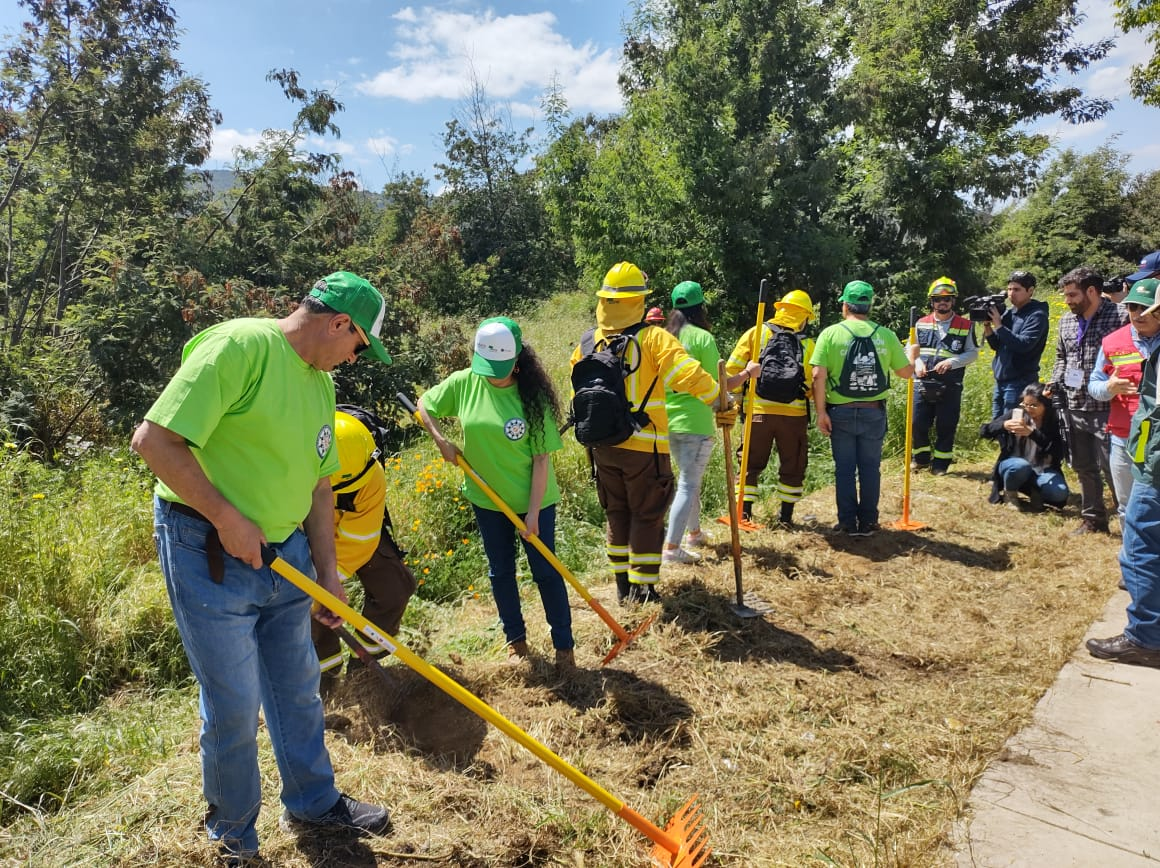
Throughout the training, communities develop local wildfire prevention plans. The programme had trained 236 communities nationally by 2023 and 275 by 2024. Community groups and local voluntary brigades play a preventative role, complementary to the formal fire department and fire management services.
Voluntary brigades receive training and can achieve qualifications. They can work alongside teams from CONAF, local fire departments, and other formal firefighting organisations.
The second programme is the Global Environment Facility (GEF)'s Restauración de Paisajes project, formally titled "Restauración de la biodiversidad y los servicios ecosistémicos a escala de paisaje en áreas productivas agroforestales y su entorno natural," which funds and technically supports on-the-ground ecological restoration work. The programme funds activities including vegetation and fuel management, native species reforestation, and sustainable land use practices, through locally agreed restoration plans.
The programme operates across seven pilot landscapes in six regions, including the bi-regional Cayumanqui landscape spanning Ñuble and Biobío, centred on Florida commune. The project works through Local Restoration Committees, multi-actor bodies bringing together community leaders, municipal staff, private landowners, NGOs, indigenous representatives, and church representatives.
In December 2024, the Food and Agriculture Organisation (FAO) Chile launched a pilot joining these two programmes together, in four communes across three regions, including Florida and Contulmo in Biobío.
CONAF's Comunidades Preparadas process produces a community prevention plan, and the GEF project then provides funding and technical support to implement specific items in that plan, rather than leaving it as a document with no resourcing behind it.
Timeline & Evolution
CONAF's Comunidades Preparadas programme has run nationally since 2015. GEF financing for Restauración de Paisajes was approved in December 2020, and the project launched publicly in January 2023 under the National Landscape Restoration Plan, targeting one million hectares restored by 2030.
The program supports grassroots responses and builds the capacity of communities who are taking action and who have had direct experience of wildfire impacts.
Case: In Salto del Laja, within Biobío near Los Ángeles, a fire that destroyed the local "El Parroncito" establishment in 2019 led residents to organise and build wildfire preparedness capacity to reduce response times for fire and rescue given the area's distance from formal emergency stations. The brigade formalised in 2020 and has since built its own equipment and training, operating as a preventative and complementary force alongside CONAF, Bomberos, and other formal firefighting units. (https://www.latribuna.cl/cronica-ciudadana/2026/08/19/biobio-refuerza-capacidad-de-respuesta-ante-meses-de-mayor-riesgo-de-incendios-forestales.html )
Actors & Governance
CONAF's Regional Office for Biobío delivers this action, working with the Regional Government of Biobío.
At the national level, the Ministry of Environment (MMA) and CONAF jointly execute the GEF project.
Within communities, local organisations and community leaders are integrated into the Comunidades Preparadas process.
Implementation Considerations
This action combines a training and planning process, Comunidades Preparadas, with a financing and technical delivery process, the GEF project, that acts on what the resulting plan actually says.
Implementation depends on working closely with communities, who sit on the front line of wildfire impact, and enabling them to deliver on the priorities they identify. The programme targets wildland-urban interface zones, selected using CONAF's own identification and assessment of areas with the highest occurrence of forest fires.
Implementation considerations include:
- Formal qualification and opportunities for volunteers
- Local coordination
- Integration with formal forestry and fire service work
- Emergency response
This sits within a multi-tiered approach to firefighting and preparedness, requiring coordination across national and regional forestry and firefighting bodies and the local community level.
Co-Benefits & Trade-Offs
Communities gain trained personnel and available resources ready when fire threatens, rather than relying solely on external response capacity.
Training gives local residents the opportunity to achieve professional certifications, a co-benefit beyond fire preparedness itself.
CONAF's provincial head for Concepción described the GEF support as reinforcing what is already defined in the community's own action plan, rather than introducing new priorities from outside.
Equity Considerations
Comunidades Preparadas participants, Local Restoration Committees, and brigades should reflect strong and equitable local representation, working with existing community groups where possible. Florida's Local Restoration Committee includes an indigenous community representative alongside a broad range of local actors, described by one committee member as receiving an excellent and validated reception across sectors, particularly rural ones.
Best Practice Principles
Pair local capacity building on forestry and firefighting with landscape restoration projects and initiatives for fire prevention. This takes a systemic approach to managing fire risk, enables delivery of ecological goals alongside fire prevention, and draws on a diverse set of budgets for fire management than a firefighting budget alone.
Maintaining year-round capacity for fire prevention and emergency preparedness is critical. Local organisations need personnel, equipment, and expertise ready throughout the year, not only during fire season. This depends on providing local people the opportunity to take on this role, with training, equipment, and support, and pairing that training with the resourcing to act. Pair planning with empowerment and support to take action.
Integrate local committees into formalised firefighting responses to support operational efficiency. This may be particularly relevant for rural and smaller communities where formal emergency services are distant or limited.
Harness community training programs, including formal accreditation, to meet needs for more competent responders as extreme weather events become more frequent.
Programmes should be delivered in communities with demonstrated need. Starting a programme in an area without high fire risk risks low interest and disconnection from the community.