
Key Information
| Title | Garde Régionale Forestière (Regional Forest Guard): A Seasonal Youth Corps for Wildfire Prevention and Public Awareness |
| Hazard | Wildfire |
| Region and Country | Région Sud (Provence-Alpes-Côte d’Azur), France |
| Action Type | Programme / seasonal workforce scheme |
| Further Categorisation | Community engagement and risk communication; prevention and surveillance |
| Key links | La guerre du feu en Région Sud La Région Sud mobilisée contre les feux de forêt |
Context
Region Sud, also known as the Provence-Alpes-Côte d'Azur Region holds 1.6 million hectares of forest, two-thirds of it in fragmented private ownership, and faces intrinsic wildfire risk from its Mediterranean climate. Wildfire prevention in the region depends on year-round public compliance with access restrictions and debroussaillement – mandatory vegetation clearance, which requires sustained on-the-ground presence in forested areas that regional and national park authorities cannot staff at scale during the summer peak season on their own.
Action Description
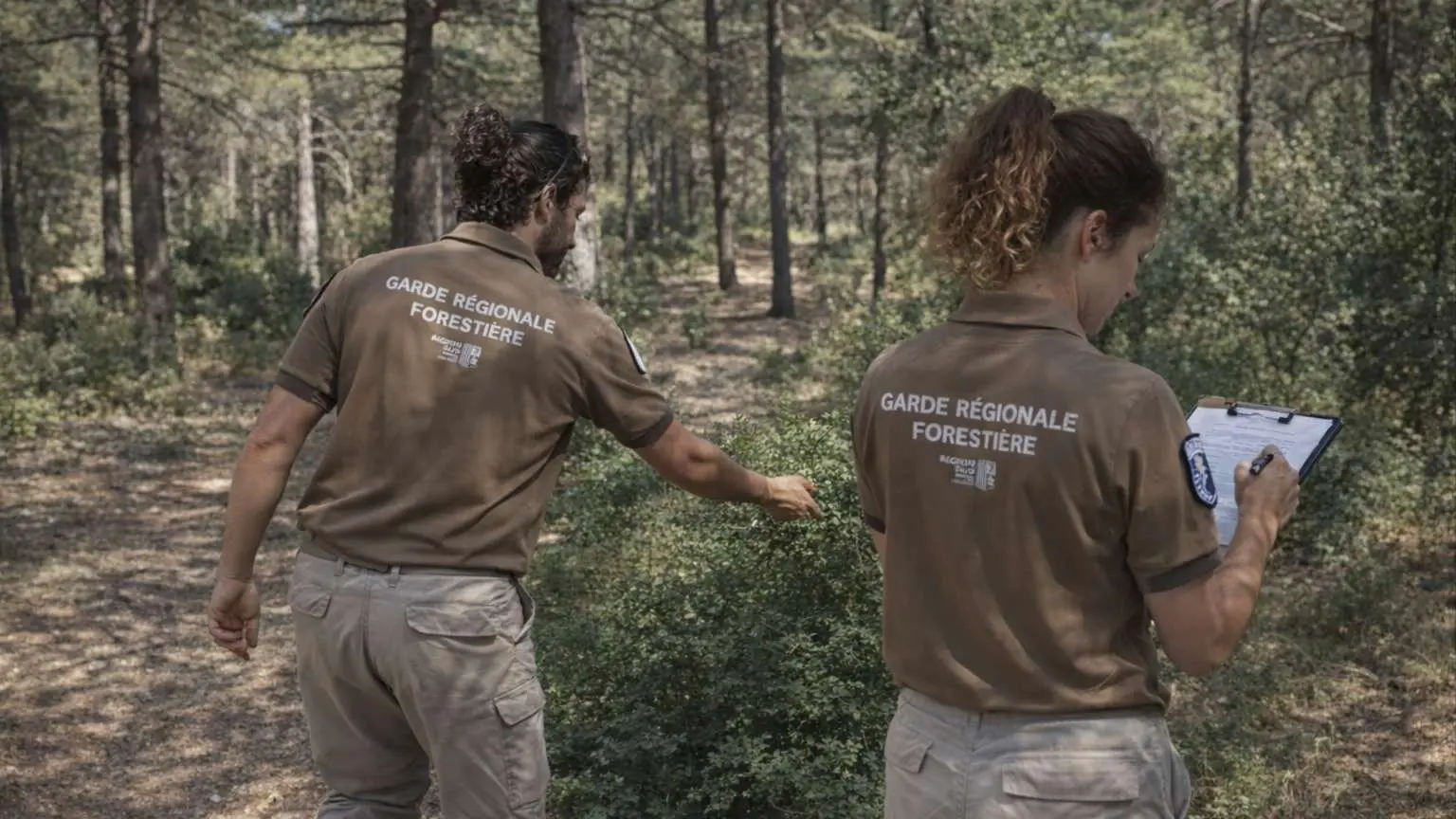
The Garde Régionale Forestière is a seasonal corps of young people aged 18 to 25, funded by Région Sud and deployed each summer to reinforce the staffing of regional and national parks and forest management bodies that host them.
This additional corps delivers critical on the ground work: raising awareness among residents and visitors about fire risks and good behavior to adopt in the forest, strengthening prevention, information and surveillance actions during the summer period, and supporting existing systems for monitoring forest areas.
In 2025, 250 guards were deployed from June until September across 21 partner territories, including nine regional natural parks (Luberon, Alpilles, Sainte-Baume, Verdon, Préalpes, Mont-Ventoux, Camargue, Baronnies, Queyras), two national parks (Port-Cros, Calanques), the Mercantour national park, several communes and intercommunal bodies, the Marseille naval fire battalion, and an Office National des Forêts (ONF) site. Guards carry out patrol, information, and public awareness missions, engaging directly with residents and tourists in forested areas.
Before deployment, guards complete one week of training covering forest ecology and the actors who manage it, fire regulations and firefighting resources, communication technique, cartography, and first aid. In 2025 the communication module was revised and strengthened, delivered by behavioural science and conflict management specialists from Sciences Po Aix, aimed at helping guards explain access restrictions to the public without provoking conflict. A biodiversity module using the Indice de Biodiversité Potentielle, a ten-criteria forest biodiversity assessment tool developed by the Centre National de la Propriété Forestière, was also added to the training in 2025.
Timeline & Evolution
The Garde Régionale Forestière has operated every summer since 2018.
The dedicated budget for the scheme rose from €1.15 million in 2022 to €1.45 million in 2023 and €1.76 million in 2024, an increasing year-on-year allocation.
The number of guards reached the Region's target of 250 by 2024 and was maintained at that level through the 2025 and 2026 seasons.
The training curriculum has been revised over time, with the communication and biodiversity modules specifically strengthened in 2025.
Actors & Governance
The Government of Région Sud funds and owns the Garde Régionale Forestière initiative directly, setting its annual budget and guard numbers. Delivery is distributed across a set of hosting organisations:
- regional and national park authorities,
- forest massif management syndicates,
- Communes- more local units of governments
- the ONF
- the Marseille naval fire battalion.
Each of these partners receive and deploy guards within the spaces that they manage.
The training for the Gardes is delivered by external experts, including fire prevention professionals and Sciences Po Aix behavioural science specialists.
The scheme sits within the Region's Plan Guerre du Feu, which the Region also owns directly, and which is in turn one action block within Plan Climat .
Cost & Resourcing
The Garde Régionale Forestière has its own dedicated budget line, within the wider Plan Guerre du Feu programme.
The budget for the Garde Regionale Forestiere has been:
- €1.15 million (2022)
- €1.45 million (2023)
- €1.76 million (2024)
This funds guard recruitment, the one-week training programme, and coordination with host territories.
As of July 2026 2025, the Plan Guerre du Feu has mobilised €40 million since 2018.
Implementation Considerations
The Region delivers this action in partnership with land managers who are able to host Gardes Forestiere. This includes: parks, communes, forest management bodies.
Delivery depends on partners having the capacity to receive, supervise, and deploy guards once trained.
The Region oversees the training of the Gardes Forestiere, and partners handle their placement and ongoing work through the fire season.
The scheme is resourced and staffed on an annual cycle timed to the June–September fire season, meaning training and placement must be completed before peak risk begins each year.
Co-Benefits & Trade-Offs
The programme responds to increased demand for the protection of natural areas across peak fire season- successfully boosting capacity through a youth employment programme. This provides needed capacity to existing fire prevention forces.
The scheme functions as a seasonal youth employment and training opportunity in addition to its prevention role.
Best Practice Principles
The Gardes Régionaux Forestiers model meets a core wildfire prevention need: additional presence in high-risk natural spaces during peak fire season- by mobilising a seasonal workforce. Mediterranean regions with the same seasonal wildfire pattern, and an existing park or protected-area network able to host guards, could adopt the same approach.
It gives a paid, skilled role tied directly to a regional resilience priority to a group that might not otherwise have access to one, which is a model other Mediterranean regions could adopt wherever seasonal public-facing prevention capacity is needed, independent of wildfire risk specifically.
Training the guards to engage the public, not only to monitor the land, builds a train-the-trainer structure into the programme. Because the Gardes engage visitors directly in the natural spaces that carry the highest fire risk, a fixed number of guards can reach a larger volume of the public than the same guards could reach through indirect messaging such as signage or campaigns alone. Direct engagement with people delivering wildfire prevention messaging is also more likely to result in behaviour change than signage.
This reservist structure builds a wider base of readiness through a region- providing paid training and short-term employment to a large cohort, most of whom will not stay in permanent forestry or fire roles, has the potential to expose a wider group across society to direct experience of wildfire prevention. This increases the chance of individuals carrying that awareness of an acute and often deadly risk into their subsequent work and communities.
The specific training partnership with an academic institution for behavioural communication skills is a key feature of the training. Other regions could build equivalent communication training into their own programmes.